Plus-que-parfait (Pluperfect)
Used to express an action that took place before another which has already taken place in the past. To express past of the past (passé du passé)
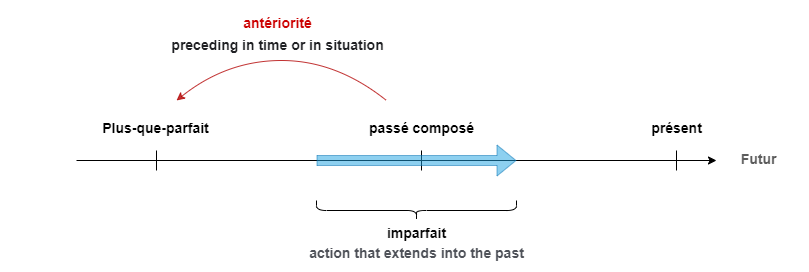
avoir or être of imperfect(imparfait) + past participle
| Verb | j' | tu | il/elle/on | nous | vous | ils/elles |
|---|---|---|---|---|---|---|
| être | étais | étais | était | étions | étiez | étaient |
| avoir | avais | avais | avait | avions | aviez | avaient |
-je n'étais jamais allé(I never went)
-j'avais aussi travaillé(I had also worked)
-il n'avait pas encore développé(he had not yet developed)
-il n'avait pas voulu aller avec eux(he had not wanted to go with them)
-elle était essoufflée parce qu'elle avait couru(she was out of breath because she had been running)
Note: for the conjugation it follwos the same rule as passé composé(perfect past) avoir/être
| avoir | être | |
|---|---|---|
| je/j' | aurai parlé | étais allé(e) |
| tu | avais parlé | étais allé(e) |
| il/elle/on | avait parlé | était allé(e) |
| nous | avions parlé | étions allé(e)s |
| vous | aviez parlé | étiez allé(e)(s) |
| ils/elles | avient parlé | étaient allé(e)s |
- to describe an action which had started in the past and was completed or negative sentence for starting action in past and continuing(using depuis(since, for)) -je n'étais pas allé au théâtre depuis des années(I had not been to the theather for years) -il était parti depuis peu(he had recently left/he had been gone for a short time)