French grammar with English
~~ ongoing project ~~
I have created the document while learning, please let me know if you feel something is wrong or not mentioned properly.
Merci
Abbreviation used in the text
- fem - feminine
- masc - masculine
- plur - plural
- sing - singular
Topics
Les article (the Articles)
- L'article défini (The definite article)
- L'article indéfini (The indefinite article)
- L'article contracté (The contracted article)
- L'article partitif (The partitive Article)
Les noms (The nouns)
- Sexe (Gender)
- La formation du féminin (The formation of feminines)
- La formation des pluriels(The formation of plurals)
Les adjectifs (The Adjectives)
- Accord des adjectifs (Agreement of adjectives)
- Les formes féminines des adjectifs (Feminine forms of the adjecives)
- Pluriels d'adjectifs (Plurals of adjectives)
- Position des adjectifs (Position of adjectives)
- Comparatif et superlatif des adjectifs (Comparative and superlative of adjectives)
- Plus d'adjectifs (More adjectives)
Les adverbes (Adverbs)
- Adverbes de manière (Adverbs of manner)
- Adverbes de temps (Adverbs of time)
- Adverbes du lieu (Adverbs of place)
- Adverbes d'intensité et de quantité (Adverbs of intensity and quantity)
- Position des adverbes (Position of adverbs)
- Comparatif et superlatif des adverbes (Comparative and superlative of adverbs)
Pronoms et adjectifs correspondants (Pronouns and corresponding adjectives)
- Démonstratifs (Demonstratives)
- Adjectifs et pronoms indéfinis (Indefinite adjectives and pronouns)
- Adjectifs et pronoms interrogatifs et exclamatifs (Interrogative and exclamatory adjectives and pronouns)
- Pronom personnel (Personal pronouns)
- Adjectifs et pronoms possessifs(Possessive adjectives and pronouns)
- Pronoms relatifs(Relative pronouns)
Verbes (Verbs)
- Verbes, temps et modes (Verbs, tenses and moods)
- Présent(Present)
- Passé (Past)
- Futur (Future)
- Imparfait (Imperfect)
- Plus-que-parfait (Pluperfect)
- Subjonctif (Subjunctive)
- Conditionnel (Condtional)
- Impératif (Imperative)
- Verbes pronominaux (Reflexive verbs)
- Verbes impersonnels (Impersonal verbs)
- Verbes infinitifs (Infinitive verbs)
- Le passif (The passive)
- Verbes auxiliaires modaux (Modal auxiliary verbs)
- Épellation irrégularités (spelling Irregularities)
- Construction du verbe (Verb construction)
- Conjugaison des verbes (Verb Conjugation)
Les accents et la poncutation (The Accents and punctuation)
Les accents
L'accent aigu (accute accent) : é (ay)
- été (summer)
- Placed mostly on letter e
L'accent grave (grave accent) : è (eh)
- mère (mother)
- Found on letters a, e, u. But the sound changes only with letter e
L'accent circonflexe (circumflex accent) : ^
- hôtel (hotel)
- Found on vowel a, e, i, o, u. Sound remain the same
l'accent cédille (cedilla accent) : ç (seh)
- garçon (boy)
- Found on c changes the sound from 'keh' to 'seh'
le tréma (Umlaut) : ë
- Noël (christmas)
- To pronounce both separatly, when 2 vowels are together.
La punctuation
' l'apostrophe (the apostrophe)
- le trait d'union (the hyphen)
. le point (full stop)
! le point d'exclamation (exlamation point)
? le point d'interrogation (question mark)
, la virgule (the comma)
<<> >> les guillemets (quotation marks as "" in english)
@ l'arobase (at sign)
___ le sous tiret (underline)
lspace (space)
a c b la minuscule (small latters)
A C B la majuscule (capital latters)
Les article défini (The definite article)
In English, there is only one form of the definite article the. In French, there are three forms, depending on the gender and number of the noun following the article.
- with a masculine singular noun: le (the)
- with a feminine singular noun: la (the)
- with a plural noun (masc or fem): les (the)
| Masc Sing | Fem Sing | Fem Sing |
|---|---|---|
| le chauffeur (the driver) | la secrétaire the secretary | Les étudieants (the students) |
| le salon ( the lounge) | la cuisine (the kitchen) | les chambres (the bedrooms) |
Note: le and la both changes to l' before vowel or silent h
| Masculine | Feminine | |
|---|---|---|
| Before Vowel | l'avion (the plane) | l'odeur (the smell) |
| Before silent H | l'homme (the man) | l'hôtesse (the hostess) |
Pronunciation: the s of the les is pronounced z when the noun following it begins with a vowel or a silent h
Use
As in English, teh definite article is used when referring to a particular personor thing, or particular persons or things:
-les amis dont je t'ai parlé (the friends I told you about)
-le café est prêt (the coffee is ready)
The definite article is used far more frequently in French:
when the noun is useed in a general sense
- refer to all things of a kind
-vous acceptez les chéques ? (do you accept cheques?)
-le sucre est mauvais porur les dents (sugar is bad for the teeth)
- to refer to abstract things
-le travail et les loisirs ? (work and leisure)
-la musique classique (classical music)
- when stating likes and dislikes
-J'aime la viande, mais je préfère le poisson (I like meat, but I prefer fish)
-je détest les tomates (I hate tomatoes)
with geographical names
- continents, countries and area
-le Canada (Canada)    la France (France)   l'Europe(Europe)
-la Bretagne (Brittany)     l'Afrique (Africa)   les Etats-Unis (the United states)
But the article la is omitted with the preposition en(to, in) and de(from)
-j'habite en France (I live in France)
-il vient d'Italie (he comes from Italy)
- mountains, lakes and rivers
-le mont Everest (Mount Everest)
-le lac de Genéve (lake Geneva)
with names of seasons
-l'automne (autumn)
-l'hiver (winter)
-le printemps (spring)
-l'été (summer)
But:
-en autumne/été/hiver (in autumn/summer/winter)
-au printemps (in spring)
-un jour d'été (a summer's day)
with names of languages
-j'aprends le français (I am learning French)
But:
-ce film est en anglais (this film is in English)
with parts of the body
-j'ai les cheveux roux (I have got red hair)
-ouvrez la bouche (open your mouth)
-les main en l'air (hands in the air/ hands up)
-l'hommes à la barbe noire (the man with the black beard)
with names following an adjective
-le petit Pierre (little Pierre)
-la pauvre Isabelle (poor Isabelle)
with titles
-le docteur Coste (Doctor Coste)
-le commandant Cousteau(Captain Cousteau)
with days of the week to express regular occurrences
-que fais-tu le samedi? (what do you do on sunday?)
with names of subjects or leisure activities
-les maths (maths)
-l'histoire et la géographie (history and the geography)
-la natation, la lecture, le football (swimming, reading, football)
in expressions of price, quantity
-c'est conbien le kilo,/la douzaine/la bouteille? (how much is it for a kil/dozen/bottle?)
L'article indéfini (The indefinite article)
In French, there are three forms of the indefinite article, depending on the number and gender of the noun it accompanies:
- with a masculine singular noun: un (a)
- with a feminine singular noun: une (a)
- with a plural noun (masc or fem): des (some)
Note: des is often not translated in english
-il y ades nauges dans le ciel (there are clouds in the sky)
Use
- Indefinite article is used in the same way as its In English
-un homme (a man)
-une femme (a woman)
-des hommes/femmes (some men/women)
-un livre (a book)
-une tasse (a cup)
-des livres/ tasses (some books/cups)
The English indefinite article is not always translates in French
- when stating someone's profession or occupation
-mon père est architecte (my father is an architect)
-elle est médecin (he is a doctor)
But : the article is used after c'est, c'est etc
-c'est un acteur célèbre (he's a famous actor)
-ce sont des fraises (these are strawberries)
- after quel in exclamation
-quel dommage! (what apity !)
-quelle suprise (what a suprise !)
In negative sentences, de (or d') is used instead of un, une, des. (it shows zero quntity of the things)
-je n'ai pas d'amis (I dont't have any friends)
-je n'ai plus de  voiture (what a suprise !)
But: with être verb no changes with negative sentences( we will learn in verbs section)
-David n'est pas un officier (David is not an officer)
In French, the indefinite article is used with abstract nouns followied by an adjective
-avec une patience remarquable (with remarkable patience)
-elle a fait des progrés étonnants (she's made amazing progress)
But : the article is not used when there is no adjective
-avec plaisir (with pleasure)
-sans hésitation (without hesitation)
L'article contracté (The contracted article)
When the prepositions à and de are combined with the definite article, they are contracted called Les articles contractés.
With the Prepositions de (of, from)
| preposition + definite | article contracté | Examples |
|---|---|---|
| de + le | du (before masc sing nouns) | - Le chapeau du garçon (the hat of the boy) - du directeur(of/from the manager) |
| de + la | de la (before fem sing nouns) | - Le pull de la fille (the sweater of the girl) - de la région (of/from the area) |
| de + l' | de l' (before masc and fem sing nouns beginning with a vowel or silent h) | - La mère de l'enfant (the mother of the child(masc)) - la mère de l'étudiante(the mother of the student(fem)) - de l'usine (of/from the factory) |
| de + les | des (before plur of masc and fem nouns) | - La mère des enfants (the mother of childrens) - des chômeurs (of/from the unemployed) |
Pronunciation: the s of des is pronounced z when the noun following it begins with a vowel or a silent h
With the Prepositions à (to , at)
| preposition + definite | article contracté | Examples |
|---|---|---|
| à + le | au (before masc sing nouns) | - il parle au garçon (he speaks/talks to the boy) - Au restaurant (at / to the restaurant) |
| à + la | à la (before fem sing nouns) | - il parle à la fille (he speaks/talks to the girl) - à la plage (at/to the beach) |
| à + l' | à l' (before masc and fem sing nouns beginning with a vowel or silent h) | - il parle à l'enfant (he speaks/talks to the child(masc)) - il parle à l'étudiante (he speaks/talks to the student(fem)) - à l’aéroport (at/to the airport) |
| à + les | aux (before plur of masc and fem nouns) | - il parle aux garçons (he speaks/talks to the boys) - Aux enfants (to the childrens) |
Pronunciation: the x of aux is pronounced z when the noun following it begins with a vowel or a silent h
Note: Before a proper noun (names), articles are not used and only the preposition à or de are used (de becomes d' before noun beginning with vowels)
- Je parle à Marie (I speaks/talks to Marie).
- C'est le pull de Marie (Its the sweater of Marie).
- Ce sont les chaussures de Pierre (these are the shoes of Pierre/ These are Pierre's shoes).
- Le père de Cathline et d'Anne (the father of Cathline and Anne/ Cathline and Anne's father).
L'article partitif (The partitive Article)
The partitive articles are used to denote an imprecise quantity which means some/any
| de + article definite | article partitifs | Examples |
|---|---|---|
| de + le | du (before masc sing nouns) | - il achète du pain (he buys some bread) - du vin(some wine) |
| de + la | de la (before fem sing nouns) | - il achète de la confiture (He buys some jam) - de la biére(some beer) |
| de + l' | de l' (before masc and fem sing nouns beginning with a vowel or silent h) | - il achète de l'eau (he buys some water(masc)) - de l'argent(some money) |
| de + les | des (before plur of masc and fem nouns) | - il achète des biscuits (He buys some biscuits) - des fruits (some fruits) |
Use
Used same as English but English tends to omit the partitive article where French does not
-achète du pain (buy (some) bread)
-vous avez du beurre? (do you have (some/any) butter?)
-je voudrais de la viande (i would like (some) meat)
-tu veux de la soup?(do you want (some) soup)
-tu dois manger des légumes(you must eat (some) vegetables)
-as-tu acheté des poires? (did you buy (any) pears)
The partitive article is replaced by the de (or d'):
- in negative expression
-il n'y a plus de café (there is no more coffee)
-je n'ai pas de verres (I don't have any glasses)
But : not replaced with être verbs (we will learn verb in later chapters)
-ce n'est pas du cuir, c'est du plastique (it's not leather, it's plastic)
- after the expression of quantity (trop de (too much), beaucoup de (a lot of), moin de(less of), assez de(enough off))
-il boit trop de café (there is no more coffee)
-il gagne assez d'argent (he earns enough money)
- after avoir besoin de
-j'ai besoin d'argent (I need (some) money)
-tu as besoin de timbres? (do you need (any) stamps?)
- where an adjective is followed by plural noun
-de grands enfants ((some) tall childrens)
-de petites villes ((some) small towns)
But: if the adjective comes after the noun, des does not changes
-des résultats encourageants ((some) encouraging results)
Note: Although the partitive articles and contracted articles with de have same spelling and pronunciation, the meanings are totally different
-il achète du pain (he buys some bread)
-il parle du professeur (hes is speaking of the professor)
Article défini ou l'article partitif
we use the partitive articles only to denote an imprecise quantity i.e. some, any. When we are talking in the general sense or about a precise quantit, we use the definite articles.
-J'aime le thé et il préfère le café (I like tea and he prefers coffee)
-Elle aime le chocolat mainelle déteste les légumes (She likes chocolates but she dislikes vegetables)
-Voilà des chocolats, j'achète le chocolat noir (Here are some chocolate, I am buying the dark chocolate)
-Voila le gâteau d'anniversaire, voulez-vous du gâteau? (Here is the anniversary cake, do you want some cake?)
Note: If some/any can be inserted before the English noun, the French partitive article should be used. But is the noun is used in general sense and inserting some/any in front of the English noun does not make sense, the definte article must be used.
- did you buy some fish? (i.e. any fish) - tu as acheté du poisson
- Yes, I like fish (i.e. fish in general) - oui, j'aime le poisson
Le sexe (the gender)
Nouns are naming words, which refers to persons, animals, things, places or abstract ideas.
All French nouns are either masculine or feminine; there is no neuter as in English. Though no absolute rule can be stated, the gender can often be determined either by the meaning or the ending of the noun.
Masculine
by meaning
- names of the people and animals:
-un homme (a man)
-le boucher (the butcher)
-le tigre (the tiger)
- names of the common trees and shrubs:
-le chêne (the oak)
-le sapin (the fir tree)
-le laurier (the laurel)
But:
-une aubépine (a hawthorn)
-la bruyère (the heather)
- days, months, season:
-lundi (Monday)
-mars (march)
-le printemps (the spring)
- rivers and countries not ending in silent e:
-le Nil (the Nile)
-le Portugal (Portugal)
-le Danemark (Denmark)
But:
-le Danube (the Danube)
-le Rhône (the Rhone)
-le Mexique (Mexico)
by ending
| Ending | Example | Exceptions |
|---|---|---|
| acle | le spectacle (show) | une débâcle (shambles) |
| age | le fromage (cheese) | la cage (cage) une image (image) la nage(swimming) la page(page) la plage(beach) la rage(rage, rabies) |
| é | le marché(market) | ending with té and tié |
| eau | le chapeau(hat) | l'eau(water) la peau(skin) |
| ège | le piège(trap) le collège(secondary school) | |
| ème | le thème(theme, topic) | la crème(the cream) |
| isme, asme | le communisme(communism) le tourisme(tourism) l'enthousiasme(enthusiasm) | |
| o | le numéro(the number) | la dynamo(dynamo) une auto (car) le météo(weather forecast) la photo(photograph) la radio (radio) la sténo(shorthand) la stéréo(stereo) |
Note: Noun ending with a consonant are usually masculine
Exceptions are:
- most noun ending with tion, sion, ation, aison, ison
- most abstract noun ending with eur
- the following nouns ending in consonant are not masculine
la clef(key)                  la nef(nave/part of the church)
la soif(thirst)               la faim(hunger)
la fin(end)                   la façon(manner/way)
la leçon(lesson)              la boisson(drink)
la moisson(harvest)           la rançon(ransom)
la mer(sea)                   la cuiller(spoon)
la chair(flesh)               la basse-cour(farmyard/barnyard)
la cour(courtyard)            la tour(tower)
la brebis(sheep)              une fois(once)
la vis(screw)                 la souris(mouse)
la part(share)                la plupart(majority/ most)
la dent(tooth)                la dot(dowery)
la forêt(forest)              la jument(mare/female horse)
la mort(death)                la nuit(night)
la croix(cross)               la noix(nut)
la paix(peace)                la perdix(partridge)
la toux(cough)                la voix(voice)
Feminine
by meaning
- names of females(people and animals):
-la mère(the mother)
-la bonne(the maid)
-la génisse(the heifer/ cow that has not yet a calf)
- names of river and countries ending in a silent e:
-la Seine(the seine)
-la Russie(Russia)
-la Belgique(Belgium)
- saint day and festivals:
-la Toussaint(all Saints' day)
-la Pentecôte(whitsun)
But: Noël(christmas) is a masculine except with the definite article: à la Noël(at Christmas)
by ending
| Ending | Example | Exceptions |
|---|---|---|
| ace | la place(square, seat) | un espace(space) |
| ade | la salade(salad) | le grade(mark/rank) le stade(stadium) |
| ance, anse | la puissance(power) la danse(dancing) | |
| ée | la soirée(evening) | le musée(museum) le lycée(secondary school) |
| ence, ense | une évidence(evidence) la défense(defence) | le silence(silence) |
| ère | la lumière(light) | le mystère(mystery) le caractère(character) |
| eur | la peur(fear) | le bonheur(happiness) le coeur(heart) un honneur(honour) le labeur(toil/hard work) le malheur(misfortune) |
| ie | la pluie(rain) | le génie(genius) un incendie(fire) le parapluie(umbrella) |
| ière | la bière(beer) | le cimetière(cemetery) |
| oire | la gloire(glory) | le laboratoire(laboratory) le pourboire(tip) |
| tion, sion, ation, aison, ison | la fiction(fiction) la nation(nation) la raison(reason) la prison(prison) | |
| té | la bonté(goodness) | le côté(side) le comté(country) le traité(treaty) le pâté(dough) |
| tié | la moitié(half) la pitié(pity) |
- most noun ending with silent e following 2 consonants:
-la botte(boot)
-la couronne(crown)
-la terre(earth)
-la masse(mass)
-la lutte(struggle)
But:
-le verre(glass)
-le parterre(compartments of flowers on the ground/garden)
-le tonnerre(thunder)
-un intervalle(interval)
-le carosse(carriage)
Difficulties
- some nouns may have either gender depending on sex of the person to whom they refer:
-un artiste(a male artist)
-une artiste(a female artist)
-le Russe(the Russian man)
-la Russe(the Russian woman)
similarly
    -un aide/ une aide(an assitant)
    -un camarade/une camarade(a friend)
    -un domestique/une domestique(a servant)
    -un enfant/ une enfant(a child)
    -un malade/ une malade(a patient)
    -un propriétaire/ une propriétaire(woman)
- others have only one gender for both sexes:
un ange(an angel)                   un amateur(an amateur)          un auteur(an author/ess)
une connaissance(an acquaintance)   la dupe(tricked)                un écrivain(a writer)
Sa Majesté(his/her Majesty)         le médecin(the doctor)          le peintre(the painter)
une personne(a person)              le poète(the port/poetess)      le professeur(the teacher)
la recrue(the recruit)              le sculpteur(thesculptor/ress)  la sentinelle(the sentry)
le témoin(the witness)              la victime(the victim)          la vedette(the film star)
- the following nouns change meaning according to the gender:
| Masculine | Feminine | |
|---|---|---|
| aide | male assistant | female assitance |
| critique | critic | criticism |
| faux | fake/forgery | scythe |
| livre | book | pound |
| manche | handle | sleeve |
| manoeuvre | labourer | manoeuvre |
| mémoire | memorandum | memory |
| mode | method/way | fashion |
| mort | dead man | death |
| moule | mould | mussel |
| page | pageboy | page |
| pendule | pendulumn | clock |
| physique | physique | physics |
| poêle | stove | frying pan |
| poste | job | post office |
| somme | nap | sum |
| tour | tour | tower |
| trompette | trumpeter | trumpet |
| vapeur | steamer | steam |
| vase | vase | silt, fine sand, clay |
| voile | veil | sail |
- gens is regarded as feminine when it follows an adjective, and masculin when it precedes it:
de bonne gens(good people) - fem
des gens ennuyeux(boring people) -  masc
La formation du féminin (The formation of feminines)
The feminine of nouns may be formed in the following ways:
Add an e to the masculine
un ami (a male friend)          une amie(a female friend)
un Hollandais(a Dutchman)       une Hollandaise(a Dutch woman)
nouns which end in e in the masculine do not change:
un élève(a male pupil) une élève(a female pupil)
- nouns ending in t and n double th final consonant:
le chien(dog)       la chienne(bitch)
le chat             la chatt(cat)
- nouns ending in er add è + r + e:
un ouvrier(workman) une ouvrière(female worker)
- nouns ending in eur changes to euse:
le vendeur(male shopkeeper) la vendeuse(female shopkeeper)
But: a few nouns ending in eur changes into eresse
le pécheaur(sinner male)        la pécheresse(sinner female)
-
nouns ending in teur changes to teuse or trice
- if the stem of the word is also that of a present participle the feminine form is in euse:
le chanteur(male singer) la chanteuse(female singer) - if the stem is not of present participle the feminine form is in trice:
le lecteur(male singer) la lectrice(female singer)
- if the stem of the word is also that of a present participle the feminine form is in euse:
-
nouns ending in f changes to ve:
le veuf(widower) la veuve(widow)
- nouns ending in eau changes to elle:
le jumeau(male twin) la jumelle(female twin)
Different words
le beau-fils(son-in-law)        la belle-fille(daughter-in-law)
le beau-père(father-in-law)     la belle-mère(mother-in-law)
le bélier(the ram)              la brebis(sheep)
le boeuf(beef)                  la vache(cow)
le canard(duck male green)      la cane(duck female brown)
le cheval(horse)                la jument(/female horse)
le cerf(stag/deer)              la biche(female deer)
le coq(cock)                    la poule(hen)
le fils(son)                    la fille(daughter)
le frère(brother)               la soeur(sister)
un homme(man)                   la femme(woman)
un jar(/male goose)             une oie(female goose)
le mâle(male)                   la femelle(female)
le neveu(nephew)                la nièce(niece)
un oncle(uncle)                 la tante(aunt)
le parrain(godfather)           la marraine(godmother)
le père(father)                 la mère(mother)
le porc(pig)                    la truie(sow)
le roi(king)                    la reine(queen)
- Add the word femme (or femelle for animals)
une femme poète(poetess)
un perroquet femelle(female parrot)
Irregular feminines
un abbé(abbot)              une abbesse(abbess) Superior of a monestery
un âne(donkey male)         une ânesse(donkey)
le comte                    la comtesse(Title of nobility count/countess)
le dieu(god)                la déesse(goddess)
le duc(duke)                la duchesse(duchess)
un Esquimau(Eskimo male)    une Esquimaude(Eskimo female)
le fou(madman)              la folle(mad woman)
un héros(hero)              une héroïne(heroine)
un hôte(host)               une hôtesse(hostess)
le maître(master)           la maîtresse(mistress)
le prêtre(prist)            la prêtress(pristess)
le prince(prince)           la princesse(princess)
le tigre(tiger)             la tigresse(tigress)
le Turc                     la Turque(Turk)
le vieux(old man)           la vieille(old woman)
La formation des pluriels(The formation of plurals)
Most nouns form their plural by adding s to the singular:
le vin          les vins(wine)
un étudiant     des étudiants(students)
nouns ending in 's', 'x' or 'z' remain unchanged:
le bras         les bras(arm)
la voix         les voix(voice)
le nez          les nez(nose)
Nouns ending in 'au', 'eau' and 'eu' add 'x' to the singular:
le tuyau            les tuyaux(drain-pipe)
le bateau           les bateaux(boat)
le jeu              les jeux(game)
But:
le landau           les landaus(pram/children's stroller)
le bleu             les bleus(Blue)
le pneu             les pneus(tyre)
Nouns ending in 'al' change to 'aux'
le journal les journaux(newspaper)
le bal              les bals(dance)
le carnaval         les carnavals(carnival)
le festival         les festivals(festival)
Nouns ending in 'ail' changes to 'aux':
le bail             les baux(lease)
le travail          les travaux(work)
le vitrail          les vitraux(stained glass window)
- Common excception in which the plural is formed in 'ail':
le chandail         les chandails(sweater)
le détail           les détails(detail)
l'épouvantail       les épouvantails(scarecrow)
l'éventail          les éventails(fan)
le rail             les rails(rail)
Nouns ending in "ou"
- seven nouns ending in ou add x in the plural
le bijou            les bijoux(jewel)
le caillou          les cailloux(pebble)
le chou             les choux(cabbage)
le genou            les genoux(knee)
le hibou            les hiboux(owl)
le joujou           les joujoux(toy)
le pou              les poux(louse)
- other nouns ending in ou add s
le clou les clous(nail)
Plural of counpound nouns
Each noun ought to be checked individually in a dictionary:
le chou-fleur       les chou-fleurs(cauliflower)
le beau-père        les beaux-pères(father-in-law)
But:
un essuie-glace     des essuis-glaces(windscreen wiper)
le tire-bouchon     les tire-bouchons(corkscrew)
Irreular plurals
un oeil             des yeux(eye)
le ciel             les cieux(sky)
Monsieur            Messieurs(Mr)
Madame              Mesdames(Mrs)
mademaoiselle       Mesdemoiselles(Miss)
Collective nouns
- singular in French but plural in English
le bétail (cattle)
la famille (family)
la police  (police)
-la police a arrêté certains grévistes
 (the police have arrested some strikers)
- plural in French but singular in English
-les nouvelles sont bonnes (the news is good)
Proper nouns
- Ordinary family names are invariable
j'ai rencontré les leblanc(I met the Leblancs)
- Historical names add s
les Stuarts(the Stuarts)
le Bourbons(the Bourbons)
Accord des adjectifs (Agreement of adjectives)
Adjectives are describing words which usually accompany a noun(or pronouns) and tell us what someone or something is like:
-une grande vile (a large city)
-un passe-temps intéressant(an interesting pastime)
-c'etait ennuyeux(its boring)
In French, adjective agreee in number and gender with the noun or pronoun they refer to. Unlike in English the adjective don't change.French adjective have four different forms which are determined by the noun they go with:
- masculine singular
- feminine singular
- masculine plural
- feminine plural
un passeport vert(a green passport)         une voiture verte(a green car)
des gants verts(green gloves)               des chaussettes vertes(green socks)
Note: If two singular words share the same adjective, the adjective will be in the plural
un foulard et un bonnet rouges(a red scarf and (a red) hat)
if one of these words is feminine, one masculine, the adjective will be in teh plural:
une robe et un manteau noirs(a black dress and (a black) coat)
Les formes féminines des adjectifs (Feminine forms of the adjecives)
General rule
Add the letter e to the masculine singular form:
| Masculine | Feminine | Meaning |
|---|---|---|
| grand | grande | tall, big |
| amusant | amusante | funny, amusing |
| anglais | anglaise | english(person) |
| bronzé | bronzée | tanned |
-un livre amusant(an amusing book)
-une histoire amusante(an amusing story)
-il est bronzé(he is tanned)
-elle est bronzée(she is tanned)
Adjective already ending in 'e'
These do not change
| Masculine | Feminine | Meaning |
|---|---|---|
| rouge | rouge | red |
| jeune | jeune | young |
| malade | malade | ill, sick |
-mon père est malade(my father is ill)
-ma mère est malade(my mother is ill)
Others
When the e is added some spellings of the adjectives changes:
- The following masculine endings generally double the final consonant before adding e:
| Masculine Ending | Feminine Ending |
|---|---|
| el | elle |
| eil | eille |
| en | enne |
| on | onne |
| as | asse |
| et | ette |
| Masculine | Feminine | Meaning |
|---|---|---|
| réel | réelle | real |
| cruel | cruelle | cruel |
| pareil | pareille | similar |
| ancien | ancienne | old |
| italien | italienne | italian |
| bon | bonne | good |
| gras | grasse | greasy |
| bas | basse | low |
| muet | muette | dumb |
| net | nette | clear |
-un probléme actuel(a current problem)
-la vie actuelle(present/current life)
-un bon conseil(good advice)
-c'est une bonne recette(it's a good recipe)
But: the feminine ending of some common adjectives in et is ète instead of ette
| Masculine | Feminine | Meaning |
|---|---|---|
| complet | complète | complete |
| incomplet | incomplète | incomplete |
| concret | conrète | concrete |
| discret | discrète | discreet |
| inquiet | inquiète | worried |
| secret | secrète | secret |
- er to ère
| Masculine | Feminine | Meaning |
|---|---|---|
| cher | chère | dear |
| fier | fière | proud |
| dernier | dernière | last |
- x to se
| Masculine | Feminine | Meaning |
|---|---|---|
| heureux | heureuse | happy |
| malheureux | malheureuse | unhappy |
| sérieux | sérieuse | serious |
| jaloux | jalouse | jealous |
But:
| Masculine | Feminine | Meaning |
|---|---|---|
| doux | douce | slow |
| faux | fausse | false |
| roux | rousse | red-haired |
| vieux | vieille | old |
- eur to esue
| Masculine | Feminine | Meaning |
|---|---|---|
| menteur | menteuse | lying |
| trompeur | tropeuse | deceitful |
But: This rule applies only when the stem of the adjective is also the stem of a present participle (eg mentant, trompant). The following five adjective simply add an e to the feminine, eur becoming eure
| Masculine | Feminine | Meaning |
|---|---|---|
| extérieur | extérieure | exterior/external |
| intérieur | intérieure | interior/internal |
| inférieur | inférieure | inferior |
| supérieur | supérieure | superior |
| meilleur | meilleure | better |
The feminine ending of the remaining adjective in teur is trice
| Masculine | Feminine | Meaning |
|---|---|---|
| protecteur | protectrice | protective |
| destructeur | destructrice | destructive |
- f to ve
| Masculine | Feminine | Meaning |
|---|---|---|
| neuf | neuve | new |
| vif | vive | lively |
| naïf | naïve | naive |
| actif | active | active |
| passif | passive | passive |
| positif | positive | positive |
| bref | bréve(exception é) | brief |
- c to che or que
| Masculine | Feminine | Meaning |
|---|---|---|
| blanc | blanche | white |
| franc | franche | frank |
| sec | sèche(exception è) | dry |
| public | publique | public |
| turc | turque | Turkish |
| grec | grecque(exception c) | Greek |
- Five adjectives that have irregualar feminine form and two masculine forms, the second one is used before words starting with a vowel or a silent h:
| Masculine | Masculine 2 | Feminine | Meaning |
|---|---|---|---|
| beau | bel | belle | beautiful |
| nouveau | nouvel | nouvelle | new |
| vieux | vieil | vieille | old |
| fou | fol | folle | mad, crazy |
| mou | mol | molle | soft |
-un beau lac(a beautiful lake)
-une belle vue(a beautiful view)
-un bel enfant(a beautiful child)
-un nouveau disque(a new record)
-la nouvelle année(th enew year)
-un nouvel ami(a new friend)
-un vieux tableau(an old painting)
-la vieelle ville(the old town)
-un vieil homme(an old man)
- Other irregular feminines:
| Masculine | Feminine | Meaning |
|---|---|---|
| favori | favorite | favorite |
| gentil | gentille | nice |
| nul | nulle | no, null |
| frais | fraîche | fresh |
| malin | maligne | shrewd, clever |
| sot | sotte | foolish |
| long | longue | long |
| aigu | aiguë | sharp |
| ambigu | ambiguë | ambiguous, not clear or decided |
| chic | chic | elegant |
| châtain | châtain | chestnut |
Pluriels d'adjectifs (Plurals of adjectives)
General rule
The masculine and feminine plural of adjective is formed by adding an s to the singular form:
-un vélo neuf(a new bike)
-des vélos neufs(new bikes)
-une belle fleur(a beautiful fleur)
-des belles fleurs(beautiful flowers)
Adjective ending in 's' or 'x'
if the masculine singular ends in s or x, there is no need to add the s:
-il est heureux(he is happy)
-ils sont heureux(they are happy)
-un touriste anglais(an English tourist)
-des touristes anglais(English tourists)
Others
Irregular masculine plurals (feminine plurals are all regular)
- al to aux
| Singular | Plural | Meaning |
|---|---|---|
| normal | normaux | normal |
| brutal | brutaux | brutal |
| loyal | loyaux | loyal |
But:
| Singular | Plural | Meaning |
|---|---|---|
| fatal | fatals | fatal |
| final | finals | finals |
| natal | natals | native |
| naval | navals | naval |
- eau to eaux
| Singular | Plural | Meaning |
|---|---|---|
| beau | beaux | beautiful |
| nouveau | nouveaux | new |
Position des adjectifs (Position of adjectives)
Unlike English, French adjective usually follows the noun:
-un métier intéressant(an interesting job)
-des parents modernes(nodern parents)
Adjectives of colour and nationality always follow the noun:
-des chaussures rouges(red shoes)
-le drapeau britannique(the British flag)
Common adjective generally comes before the noun:
| Adjective | Meaning |
|---|---|
| beau | beautiful |
| bon | good |
| court | short |
| gentil | nice |
| grand | big, tall |
| gros | fat |
| haut | high |
| jeune | young |
| joli | pretty |
| long | long |
| mauvais | bad |
| méchant | mean, nasty |
| meilleur | better |
| moindre | lesser, least |
| petit | small |
| pire | worse |
| vieux | old |
| vilain | ugly, nasty |
Some adjective hvae different meaning according to their position:
| Adjective | Before noun | After noun |
|---|---|---|
| ancien | former | ancient |
| brave | good | brave |
| certain | some | sure |
| cher | dear | expensive |
| dernier | last | last(= latest) |
| grand | great(people) | big, tall |
| même | same | very |
| pauvre | poor(pitiable) | poor(not rich) |
| seul | single, only | alone, lonely |
| simple | mere | simple |
| vrai | real | true |
-mon ancien mêtier(my formaer job)                  un tableau ancien(an old painting)
-un brave type(a nice fellow)                       un homme brave(a brave man)
-un certain charme(a certain charm)                 un fait certain(a definite fact)
-chère Chloé(Dear Chloé)                            un cadeau cher(an expensive gift)
-une grande vedette(a great star)                   un homme assez grand(a fairly tall man)
-la dernière séance(the last performace)            le mois dernier(last month)
-le même endroit(the same place)                    la vérité même(the truth itself)
-mon pauvre ami!(my poor friend!)                   des gens pauvres(poor people)
-mon propre frère(my own brother)                   une chambre propre(a clean room)
-mon seul espoir(my only hope)                      un homme seul(a lonely man)
-un simple employé(an ordinary employee)            des goûts simple(simple tastes)
-un vrai casse-pieds(a real pain in the ass)        une histoire vraie(a true story)
If number of adjectives are there, same rule will be applied to each of them
-le bon vieux temps(the good old days)
-un joli foulard rouge(a pretty red scarf)
Comparatif et superlatif des adjectifs (Comparative and superlative of adjectives)
Persons or things can be compared by using:
- the comparative form of the adjective:
- the superlative form of the adjective:
The comparative
Formation:
plus ... (que) (more..., ...er(than))
plus long (longer)
plus cher (more expensive)
moins... (que) (less...than)
moins long (less long)
moins récent (less recent)
aussi...(que) (as...(as))
aussi bon (as good)
aussi important (as important/ enough important)
-une plus grande maison(a larger house)
-un village plus ancien(an older village)
-le football est-il plus populaire que le rugby?(is football more popular than rugby?)
-ces gant sont moins chauds que les autres(these gloves are less warm than the others)
-elle est beaucoup/ bien moins patiente que lui (she is much/much less patient than him)
-le problème de la pollution est tout aussi grave(the pollution problem is just as serious)
The superlative
Formation:
le/la/les plus..., le/la/les moins... (the most..., the ...est, the least ...)
-le plus grand pays(the largest country)
-la plus grande ville(the largest city)
-les plus grands acteurs(the greatest actors)
-les plus grandes voiture(the largest cars)
Word order
- Same rules are applied and adjectives. when a superlative adjective comes after the noun, the article is used twice, before the noun and before the adjective.
-le plat le plus délicieux(the most delicious dish)
-l'histoire la plus passionnante(the most exciting story)
- When a possessive adjective is used there are two constructions, depending on the position of the adjective.
-ma plus forte matière(my best subject)
    or
- son besoin le plus urgent est de trouver un emploi(his most urgent need is to find a job)
'in' is normaly translated by 'de'
-la plus jolie maison du quartier/de la ville(the prettiest house in the area/town)
-le restaurant le plus cher de France(the most expensive restaurant in France)
Note: Verbs following the superlative ususally take the subjunctive (see verbs)
Irregular comparatives and superlatives
| Adjective | Comparative | Superlative |
|---|---|---|
| bon(good) | meilleur(better) | le meilleur(best) |
| mauvais(bad) | pire plus mauvais(worse) | le pire le plus mauvais(the worst) |
| petit(small) | moindre plus petit(smaller, lesser) | le moindre le plus petit(the smallest, the least) |
Note: Plus mauvais is used in the sense of the worse in quality, taste, moindre means 'less in importance', plus petit means 'less in size'
-le moindre de mes soucis(the least of my worries)
-elle est plus petit que moi(she is smaller than I am)
Plus d'adjectifs (More adjectives)
| Singular | Plural | English | ||
|---|---|---|---|---|
| Masculine | Feminine | Masculine | Feminine | Meaning |
| adorable | adorable | adorables | adorables | adorable |
| aimable | aimable | aimables | aimables | kind |
| amer | amêre | amers | amêres | bitter |
| amusant | amusante | amusants | amusantes | amusing, funny |
| antipathique | antipathique | antipathiques | antipathiques | unpleasant |
| autre | autre | autres | autres | other |
| bas | basse | bas | basses | low |
| bizarre | bizarre | bizarres | bizarres | wierd, strange |
| bleu | bleue | bleus | bleues | blue |
| blond | blonde | blonds | blondes | blonde |
| bouclé | bouclée | bouclés | bouclées | curly (in ringlets) |
| brun | brune | bruns | brunes | brown |
| bête | bête | bêtes | bêtes | stupid |
| carré | carrée | carrés | carrées | square |
| chaque | chaque | chaque | chaque | each |
| charmant | charmante | charmants | charmantes | charming |
| chauve | chauve | chauves | chauves | bald |
| clair | claire | clairs | claires | bright |
| content | contente | contents | contentes | happy |
| célèbre | célèbre | célèbres | célèbres | famous |
| dangereux | dangereuse | dangereux | dangereuses | dangerous |
| dernier | dernière | derniers | dernières | last |
| drôle | drôle | drôles | drôles | funny |
| ennuyeux | ennuyeuse | ennuyeux | ennuyeuses | boring |
| épais | épaisse | épais | épaisses | thick |
| étroit | étroite | étroits | étroites | narrow |
| excellent | excellente | excellents | excellentes | excellent |
| fatigué | fatiguée | fatigués | fatiguées | tired |
| foncé | foncée | foncés | foncées | dark |
| formidable | formidable | formidables | formidables | wonderful |
| fort | forte | forts | fortes | strong |
| français | française | français | françaises | french |
| frisé | frisée | frisés | frisées | curly (hair) |
| gentil | gentille | gentils | gentilles | kind, nice |
| grand | grande | grands | grandes | big, tall |
| gros | grosse | gros | grosses | fat |
| généreux | généreuse | généreux | généreuse | generous |
| haut | haute | hauts | hautes | high |
| heureux | heureuse | heureux | heureuses | happy |
| intelligent | intelligente | intelligents | intelligentes | intelligent |
| intéressant | intéressante | intéressants | intéressantes | interesting |
| jaloux | jalouse | jaloux | jalouses | jealous |
| jaune | jaune | jaunes | jaunes | yellow |
| joli | jolie | jolis | jolies | pretty |
| laid | laide | laids | laides | ugly |
| large | large | larges | larges | wide |
| lent | lente | lents | lentes | slow |
| lourd | lourde | lourds | lourdes | heavy |
| léger | légere | légers | légeres | light |
| magnifique | magnifique | magnifiques | magnifiques | magnificent |
| marron | marron | marron | marron | maroon |
| mince | mince | minces | minces | thin |
| mouillé | mouillée | mouillés | mouillées | wet |
| méchant | méchante | méchants | méchantes | mean, wicked |
| mécontent | mécontente | mécontents | mécontentes | unhappy |
| neuf | neuve | neufs | neuves | new |
| orange | orange | orange | orange | orange |
| petit | petite | petit | petites | small |
| plein | pleine | pleins | pleines | full |
| premier | première | premier | première | first |
| quelque | quelque | quelques | quelques | few, some |
| raide | raide | raides | raides | straight (hair) |
| rond | ronde | ronds | rondes | round |
| rose | rose | roses | roses | pink |
| rouge | rouge | rouges | rouges | red |
| salé | salée | salés | salées | salty |
| seul | seule | seuls | seules | alone |
| souriant | souriante | sourianttes | souriantes | cheerful |
| sucré | sucrée | sucrés | sucrées | sweet |
| synphathique | synphathique | synphathiques | synphathiques | pleasant |
| trite | trite | trites | trites | sad |
| vert | verte | verts | vertes | green |
| vif | vive | vifs | vives | active, lively |
Irregulars
| Singular | Plural | English | ||
|---|---|---|---|---|
| Masculine | Feminine | Masculine | Feminine | Meaning |
| beau (bel) | belle | beaux | belles | beautiful |
| blanc | blanche | blancs | blanches | white |
| doux | douce | doux | douces | slow, gentle |
| favori | favorite | favoris | favorites | favourite |
| fou (fol) | folle | fous | folles | crazy |
| frais | fraîche | frais | fraîches | fresh |
| franc | franche | francs | franches | frank |
| long | longue | longs | longues | long |
| menteur | menteuse | menteurs | menteuses | lair |
| mou (mol) | molle | mols | molles | soft |
| nouveau (nouvel) | nouvelle | nouveaux | nouvelles | new |
| public | publique | publics | publiques | public |
| sec | sêche | secs | sêches | dry |
| secret | secrète | secrets | secrètes | secret |
| tout | toute | tous | toutes | all |
| travailleur | travailleuse | travailleurs | travailleuses | hardworking |
| vieux (vieil) | vieille | vieux | vieilles | old |
Adverbes de manière (Adverbs of manner)
Adverbs are normally used with a verb to express an action is done (how, when, where, with how much intensity, to what extent). Respectively there are adverbs of manner, time, place, intensity, quantity.
Adverbs of manner are usually formed by adding -ment to the adjective(same as ly in english)
- If the adjetive ends in a consonant ment is added to its feminine form
| Adjective(masc, fem) | Adverb |
|---|---|
| doux, douce(soft) | doucement(softly) |
| franc, franche(frank) | franchement(frankly) |
| final, finale(final) | finalement(finally) |
- If the adjetive ends in a vowel ment is added to its masculine form
| Adjective(masc, fem) | Adverb |
|---|---|
| absolu(absolute) | adsolument(adsolutely) |
| désespéré(desperate) | désespérément(desperaltely) |
| vrai(true) | vraiment(truly) |
| simple(simple) | simplement(simply) |
But:
| Adjective(masc, fem) | Adverb |
|---|---|
| gai(cheerful) | gaiement/ gaîment(cheerfully) |
| nouveau(new) | nouvellement(newly) |
| vrai(true) | vraiment(truly) |
| fou(mad) | follement(madly) |
- e of feminine form is changed to é before adding
| Adjective(masc, fem) | Adverb |
|---|---|
| commun(common) | communément(commonly) |
| précis(precise) | précisément(newly) |
| profond(deep) | profondément(deeply) |
| énorme(enormous) | énormément(enormously) |
| aveugle(blind) | aveuglément(blindly) |
- Adjective which are ending in ent and ant change to emment and amment
| Adjective(masc, fem) | Adverb |
|---|---|
| prudent(careful) | prudemment(carefully) |
| évident(obvious) | évidemment(obviously) |
| brillant(brilliant) | brillamment(deeply) |
But:
| Adjective(masc, fem) | Adverb |
|---|---|
| lent(slow) | lentemment(slowly) |
- irregular adverbs
| Adjective(masc, fem) | Adverb |
|---|---|
| bon(good) | bien(well) |
| bref(brief) | brièvement(briefly) |
| gentil(kind) | gentiment(kindly) |
| mauvais(bad) | mal(badly) |
| meilleur(better) | mieux(better) |
- Some adjectives are directly used as adverbs in certain expressions
-parler bas/ haut or fort(to speak softly/ loudly)
-coûter/payer cher(to cost/pay a lot)
-s'arrêter court(to stop short)
-couper court(to cut short)
-voir clair(to see clearly)
-marcher droit(to walk straight)
-travailler dur(to work hard)
-chanter faux/juste(to sing off key/in tune)
-sentir mauvais/bon(to smell bad/good)
-refuser net(to refuse point blank)
- In French after the verbs of saying and looking + adjective, the phrase is often translated to an adverb
-"tu m'écriras ?" dir-il d'une « voix triste » (will you wrte to me ? he said « sadly »)
-elle nous a regardés d'un air « dédaigneux » (she looked at us disdainfully)
- Preposition followed by noun can be expressed as adverbs
sans soin (carelessly)
avec fierté (proudly)
avec amour (lovingly)
Adverbes de temps (Adverbs of time)
| Adverb | Meaning |
|---|---|
| alor | then, so |
| après | afterwards |
| aujourd'hui | today |
| aussitôt | at once |
| bientôt | soon |
| d'abord | first |
| déjà | already |
| demain | tomorrow |
| encore | still, again |
| pas encore | not again, not yet |
| hier | yesterday |
| parfois | sometimes |
| rarement | seldom, rarely |
| souvent | often |
| tard | late |
| tôt | early |
| toujours | always |
| tout de suite | immediately |
-c'est déjà Noël ! (its Christmas already)
-tu as déjà essayé?(have you tried already)
-il mange encore!(he's still eating!/ he's eating again)
-elle n'est pas encore arrivée(she hasn't arrived yet)
Adverbes du lieu (Adverbs of place)
| Adverb | Meaning |
|---|---|
| ailleurs | somewhere else |
| ici | here |
| là | there |
| loin | far away |
| dessus | on top, on it |
| au-dessus | over, above |
| dessous | underneath |
| au-dessous | below |
| dedans | inside |
| dehors | outside |
| devant | in front, ahead |
| derrière | behind |
| partout | evrywhere |
-ne restez pas dehors!(don't stay outside)
-mon nom est marqué dessus(my name is written on it)
-qu'est-ce qu'il y a dedans?(what's inside?)
-passez devant(go in front)
Adverbes d'intensité et de quantité (Adverbs of intensity and quantity)
| Adverb | Meaning |
|---|---|
| à peine | hardly |
| assez | enough, quite |
| autant | as much/ many |
| beaucoup | a lot, much/many |
| combien | how much/many |
| comme | how |
| moins | less |
| plus | more |
| presque | nearly |
| peu | little |
| seulemnt | only |
| si | so |
| tant | so much/many |
| tellement | so much/ many |
| très | very |
| trop | too, too much/many |
| un peu | a little |
-vous avez assez bu!(you've had enough to drink!)
-il ne fait pas assez chaud(it's not warm enough)
-nous avons beaucoup ri(we laughed a lot)
-comme c'est amusant!(how funny)
-je vais un peu mieux(I am feeling a little better)
-elle parle trop(she talks too much)
-c'est si fatigant!(it's so titing)
-il est très timide(he's very shy)
Note: All of the above adverbs, except à peine, comme, presque, si, très, seulment may be followed by de and a noun to express quantity
beaucoup de(a lot)              trop de(too much)
un peu de(a little)             assez de(enough)
moins de(less)                  plus de(more)
tant de(so much)                combien de(how much, how many)
Position des adverbes (Position of adverbs)
- Adverbs usually follow verbs
-je vais rarement au théâtre(I rarely go to the theatre)
-comme vous cinduisez prudemment!(you do drive carefully!)
- With compound tenses, shorter adverbs usually come between the auxiliary and the past participle
Note: auxiliary verb is a verb that is used with another verb to form tenses, negatives, and questions. In English the auxiliary verbs are 'be', 'have', and 'do'
-j'ai enfin terminé(I have finished at last)
-nous y sommes souvent allés(we have often gone there)
-il me l'a déjà dit(he already told me)
-elle avait beaucoup souffert(she had suffered a lot)
- Adverbs of place and time many follow the past participle
-je l'ai rencontré hier(I ment him yesterday)
-elle avait cherché partout(she looked everywhere)
-mettez-le dehor(put it outsisde)
-tu t'es couché tard?(did you go to bed late?)
- Adverbs usually come before adjectives or other adverbs
-trés rarement(very rarely)
-trop vite(too quickly)
-elle est vraiment belle(she is really beautiful)
Comparatif et superlatif des adverbes (Comparative and superlative of adverbs)
Formed as same way as adjectives
| Adverb | Comparative | Superlative |
|---|---|---|
| souvent(often) | plus souvent (que)more often (than)moins souventless often(than)aussi souvent(que)as often(as) | le plus souvent(the most often)le moins souventthe lest often |
Note:
- as...as possible is translated either by aussi...que possible or by le plus...possible
as far as possible          -aussi loin que possible (or)
                            -le plus loin possible
- after a negative, aussi os often replace by si
-pas si vite!(not so fast!)
- In French, the idea of not so, not as is often expressed by moins(less)
-parle moins fort!(don't talk so loud!)
Irregular comparatives and superlatives
| Adverb | Comparative | Superlative |
|---|---|---|
| beaucoup (much, a lot) | plus (more) | le plus (the most) |
| bein (well) | mieux (better) | le mieux (the best) |
| mal (badly) | pis or plus mal (worse) | le pis or le plus mal (the worst) |
| peu (little) | moins (less) | le moins (the least) |
Note
- mieux/le mieux must not be confused with meilleur/le meilleur. which are adjective, used in front of noun.
- pis/le pis are only found in certain set of expression
-tant pis(too bad)
-de mal en pis(from bad to worse)
Démonstratifs (Demonstratives)
Pronouns are words that stands for noun
Demonstrative adjective
a) CE
ce is often used to point out a particular person or thing, or persons or things. It is followed by the noun it refers to and agrees in the number and gender with that noun
- with a masculine singular noun: ce(cet) (this/that)
- with a feminine singular noun: cette (this/that)
- with a plural noun (masc or fem): ces (these/that)
-ce roman m'a beaucoup plu(I really liked this novel)
-il a neigé ce matin(it snowed this morning)
-cette  chanson m'énerve(that song gets on my nerves)
-cette fois, c'est fini!(this time, it's over!)
-tu trouves que ces lunettes me vont bien?(you found/think these glasses suits me?)
cet is used instead of ce in front of a word beginning with a vowel or a silent h
-cet après-midi(this afternoon)
-cet hôtel(that hotel)
b) CI and LÀ
In French there is not separate words to distinguish 'this' and 'that'. However, when a particular emphaisis is placed on a person or object, or when a contrast is being made between persons or objects, ci and là are added to the noun
- ci tranlates the idea of this/these
- là translate the idea of that/those
If the speaker wants to specify exactly which noun he is referring to in relation to its distance from the said noun, ci or la is added at the end of the noun. ci points out the item's nearness to the speaker(kind of here), là to mean that it is far from him (kind of there).
-Prends cette valise-ci(Take this case)
-Est-ce que tu reconnais cette personne-là?(Do you recognize that person?)
-je suis très occupé ces jours-ci(I am very busy these days)
-que faisiez-vous ce soir-là?(what were you doing that evening?)
Demonstrative pronouns
They are used instead of a noun with ce/cette/ces.
a) Celui
- celui agrees in number and gender with the noun it refers to. It has four different forms
| Masculine | Feminine | |
|---|---|---|
| Singular | celui | celle |
| Plural | ceux | celles |
celui, celle, ceux and celles cannot be used on their own, they are use
-
with ci or là for contrast
  celui-ci        celle-ci            this(one)
  celui-là        celle-là            that(one)
  ceux-ci         celles-ci           these(ones)
  ceux-là         celles-là           those(ones)
-j'aime bein ce maillot, mais celui-là est moins cher(I like this swimsuit, but that is cheaper)
-je voudrais ces fleur -- lequelles? celle-ci ou celles-là?(I'd like those flowers -- which ones? these or those)
- with de + noun, to express possession
-je préfère mon ordinateur à celui de Jean-Claude(I prefer my computer to Jean Claude's(that of Jean Claud))
-range ta chambre plutôt que celle de la soeur(arrange/tidy your own bedroom rather than your sister's(that of your sister))
-mes parents sont moins sévères que ceux de Nicole(my parents are less strict than Nicole's(those of Nicole))
-les douches municipales sont mieux que celles du camping(the public showers are better than those at the camping)
-
with relative pronouns qui, que, dont to introduce a relative clause(relative pronouns - further section in the chapter)
  celui/celle/ceux/celles qui     the one(s) who/which
  celui/celle/ceux/celles que     the one(s) whom/which
  celui/celle/ceux/celles dont    the one(s) which/whose
-lequel est ton père? celui qui a une moustache?(which one is your father? the one who have a moustache? /the one with a moustache?)
-regarde cette voiture! celle qui est garée au coin(look at this car! the one parked on the corner)
-deux filles, celles qu'il avait rencontrées la veille(two girls, the ones who had met the day before)
-voilà mon copain, celui dont je t'ai parlé l'autre jour(here is my friend, the one which I told you about the other day)
a) Ce
-
ce (means it, that) is mostly found with th verb être
  c'est               ce serait               c'était
  (it's/that's)       (it/that would be)      (it/that was)
Note: ce changes to c' before an e or an é
- use of ce
with a noun or pronoun, ce is used to identify people or things, or to emphasize them; it is translated in avariety of ways
-qu'est-ce que c'est? -c'est mon billet d'avion(what is that? it's my plane ticket)
-qui est-ce? - c'est moi(who is it? - it's me)
-ce doit être lui(that must be him)
-c'est un artiste bein connu(he is a well known artist)
-c'était une bonne idée(it was a good idea)
-ce sont mes amis(they are my friends)
-c'est la dernière fois(it's the last time)
-c'est elle qui l'a fait(it's she who did it)
-c'est celui que j'ai vu(that is the one who I saw)
before an adjective, ce is used to refer to an idea, an event or a fact which has already been mentioned, it does not refer to any specific noun
-c'était formidable(it was wonderful)
-ce serait amusant(it would be funny)
-oui, c'est vrai(yes,that is true)
-c'est sûr?(is that definite/certain?)
-ce n'est pas grave(it doesn't matter/ it's not serious)
-c'est bon à entendre(that is good to hear)
Note: the translation of it is difficult as it is translated b ce or il/elle(future)
a) Ceci, cela, ça
ceci(this), cela(that) and ça(that) are used to refer to an idea, an event, a fact or an object. They never refer to a particular noun already mentioned.
-non, je n'aime pas ça!(no, I don't like that)
-ah,bon? cela m'étonne(really? that surpises me)
-souvenez-vous de ceci(remember this)
-ça, c'est un acteur !(that's an actor!)
-ça m'est égal(I don't mind/ I do not care)
-cela ne vous regarde pas(this is/that's none of your business)
-buvez ceci, ça vos fera du bien(drink this, it will do you good)
-ça alors !(well, really!/ Wow)
-cela s'appelle comment, en anglais?(how do you call it in English?)
Note: ceci is not very common; cela and ça are often used to translate 'this' as well as 'that'; ça is used more frequently than cela
Adjectifs et pronoms indéfinis (Indefinite adjectives and pronouns)
Indefinite adjective
| Masculine | Feminine | Meaning |
|---|---|---|
| autre(s) | autre(s) | other |
| certain(s) | certaine(s) | certain |
| chaque | chaque | each, every |
| même(s) | même(s) | same |
| plusieurs | plusieurs | several |
| quelque(s) | quelque(s) | some |
| tel(s) | telle(s) | such |
| tout(s) | toute(s) | all, every |
a) Chaque and plusieurs
chaque(each) is always singular, plusieurs(several) is always plural; feminine and masculine form are same
-j'y vais chaque jour(I go there every day)
-chaque personne(each person)
-plusieurs années(several years)
-il a plusieurs amis(he's got several friends)
b) Autre, même and quelque
autre(other), même(same) and quelque(some) agree in number with the noun that follows, feminine and masculine form are same
-je voudrais un autre café(I would like another coffee)
-d'autres couleurs(other colours)
-la même taille(the same size)
-les mêmes touristes(the same touristes)
-quelque temps après(some time later/ After some time)
-à quelques kilomètres(a few kilometers/ a few kilometers away)
Note: même has a different meaning when placed after noun(Position des adjectifs (Position of adjectives))
b) Certian, tel and tout
certain(certain, some), tel(such) and tout(all) agrees in the number nad gender with the noun, they have 4 rspective forms
| Singular | Plural | English | ||
|---|---|---|---|---|
| Masculine | Feminine | Masculine | Feminine | Meaning |
| tout | toute | tous | toutes | all |
| tel | telle | tels | telles | such |
| certain | certaine | certains | certaines | certain |
-un certain charme(a certain charm)
-une certaine dame(a certain lady)
-à certains moments(at certain moments/times)
-certaines personnes(come people)
-un tel homme(such a man)
-une telle aventure(such an adventure)
-de tels avantages(such advantages)
-de telles difficultés(such difficulties)
-quoi! tu as mangé tout le fromage et tous les fruits?(what! you have eaten all the cheese and all the fruits?/what! did you eat all the cheese and all the fruit?)
-tout la jourée(all day long)
-toutes mes matières(all my subjects)
Note
-
tel the position of the article un/une with tel is not the same as in English(un tel homme = such a man)
-
tel cannot qualify another adjective; when it is used as an adverb, 'such' is translated by si or tellement(so)
c'était un si bon repas/un repas tellement bon!(it was such a good meal!) -
tous les/toutes les are often translated by 'every':
  tous les jour(every day)
  toutes les places(all seats, every seat)
Indefinite pronouns
| Masculine | Feminine | Meaning |
|---|---|---|
| aucun | aucune | none, not any |
| autre(s) | autre(s) | another one, other ones |
| certains | certaine(s) | certain, some |
| chacun | chacune | each one, everyone |
| on | on | one, someone, you, they, people, we |
| personne | personne | nobody |
| plusieurs | plusieurs | several (ones) |
| quelque chose | quelque chose | something, anything |
| quelqu'un | quelqu'un | someone |
| quelques-uns | quelques-unes | some, a few |
| rien | rien | nothing |
| tout(tous) | toute(s) | everything, everyone, all |
-pas celui-là, l'autre(not that one, the other one)
-où sont les autres?(where are the others?)
-certains disent que...(some say that)
-personne n'est venu(no one came)
-qui est là ? --personne(who's there ? -- nobody)
-qu'as-tu? --rien(what do you have/what is wrong with you? -- nothing)
-plusieur d'entre eux(several of them)
-chacun pour soi!(everyone for themselves!)
-il manque quelque chose ? (he is missing anything ?)
-dis quelque chose !(say something !)
-quelqu'un l'a averti(someone warned him)
-il y a quelqu'un ?(is anyone in?)
-j'ai tout oublié(I have forgotten everything)
-c'est tout, merci(that is all, thanks)
-elles sont toutes arrivées(they all arrived)
allons-y tous ensemble(let's all go together)
Points to note
-
aucun(e), personne and rien can be used on their own, but they are more often used with a verb and the negative word ne(future)
-personne n'habite ici(no one live here) -il n'y a rien à manger(there is nothing to eat) -
when aucun(e), un(e) autre, d'autres, certain(e)s, plusieurs and quelques-un(e)s are used as direct objects, the pronouns en must be used before verb
-je n'en ai lu aucun(I have not read any(of them)) -donne-m'en une autre(give me another one) -j'en ai vu d'autres qui étaient moins chers(I saw other ones which were cheaper) -j'en connais certains(I know some of them) -il y en a plusieurs(there are several) -tu m'en donnes quelques-uns ?(can you give me some?) -achètes-en quelques-unes(buy a few/ buy some) -
when personne, quelque chose, rein, plusieurs are followed by an adjective, the preposition de(d') must be used in front of hte adjective
-il n'y a personne de libre(there is no one available/ there is no one free) -quelque chose de mieux(something better) -il y en avait plusieurs de cassés(there were several broken ones) -rien de grave(nothing serious) -
autre is commonly used in hte following expressions
  -quelqu'un d'autre(someone else)
  -quelque chose d'autre(something else)
  -rien d'autre(nothing else)
On
-
Can mean one/you/they/people in a general sense
-en France, on roule à droite(in France, they drive on the right) -on ne sait jamais(you/one never know(s)) -on ne doit pas mentir(you should not lie) -
someone (an undefined person)
-on me l'a déjà dit(someone's already told me/ I've already been told) -on vous l'appoertera(it will be brought to you) -
on is usually used for nous(we), although it refers to a plural subject, it is followed by third person singular
  -qu'est-ce qu'on fait?(what are we doing?/ what do we do?/what shall we do?)
  -fais vite, on t'attend!(hurry up! we are waiting for you!)
Note: in compound tenses with the auxiliary être, the agreement of the past participle with on is optional
-on est allé au cinéma/ on est allés au cinéma(we went to the cinema)
-on est rentré en taxi/ on est rentées en taxi(we came back by taxi/ we returned back by taxi)
Adjectifs et pronoms interrogatifs et exclamatifs (Interrogative and exclamatory adjectives and pronouns)
The interrogative adjective QUEL
Forms
quel (which, what) agrees in the number and gender with the noun it refers to
- with a masc sing noun quel ?
- with a fem sing noun quelle ?
- with a masc plur noun quels ?
- with a fem plur noun quelles ?
Direct questions
-quel est votre passe-temps favori ?(what is your favourite pastime ?)
-quelle heure est-il?(what time is it?)
-quels jours as-tu de libres ?(which days have you got free ?)
-quelles affaires comptes-tu prendre avec toi ?(what/which things do you intend to take with you ?)
Indirect questions
-je ne sais pas quel disque choisir(I do not know which record to choose)
-il se demande quelle veste lui va le mieux(he is wondering which jacket suits him best)
The exclamatory adjective QUEL
quel ! has the same forms as the interrogative asjective quel ?
-quel dommage!(what a pity!)
-quelle belle maison!(what a beautiful house!)
-quels imbéciles!(what idiots!)
Interrogative pronoun
    lequel/laquelle/lesquels/lesquelles ?       which one/ones ?
    qui ?                                       who/whom ?
    que ?                                       what ?
    quoi ?                                      what?
    ce qui                                      what
    ce que                                      what
ce qui and ce que are used only in indirect question; all other interrogative pronouns can be used both in direct and indirect questions.
Lequel ?
lequel(which, which one) agrees in gender and in number with the noun it stands for
- with a masc sing noun lequel ? which one ?
- with a fem sing noun laquelle ? which one ?
- with a masc plur noun lesquels ? which ones ?
- with a fem plur noun lesquelles ? which ones ?
after the prepositions à and de, the following changes occur
    à + lequel ?         ->      auquel ?
    à + lesquels ?       ->      auxquels ?
    à + lesquelles ?     ->      auxquelles ?
    de + lequel ?        ->      duquel ?
    de + lesquels ?      ->      desquels ?
    de + lesquelles ?    ->      desquelles ?

    à/de laquelle ? do not changes
Direct question
-je cherche un hôtel ; lequel recommandez-vous ?(I am looking for a hotel; which one do you recommand?)
-nous avons plusieurs couleurs ' vous préférez laquelle ?(we have several colours ; which one do you prefer ?)
-lesquels de ces livre sont à toi ?(which (one) of these books are yours ?)
-je voufrais essayer ces chausssures -- lesquelles?(I would like to try these shoes on - which ones ?)
Indirect question
-demande-lui lequel de ces ordinateur est le moins cher(ask him which one of these computers is the cheapest)
-c'est dans une de ces rues, mais je ne sais plus laquelle(it's in one of these streets, but I don't know which one)
Qui ?
qui (who, whom) is used to refer to people; it can be both subject and object and can be used after a preposition
-qui t'a accompagné ?(who accompanied you)
-qui as-tu appelé?(who did you call?)
-tu y vas avec qui?(who are you going with?)
-c'est pour qui?(who is it for?)
-pour qui vous prenez-vous?(who do you think you are?)
-à qui l'as-tu donné?(who did you give it to?)
Note: que(not qui!) changes to qu' before vowel or a silent h
-qui est-ce qu'elle attend?(who is she waiting for?)
qui ? can be replaced by qui est-ce qui? (subject) or qui est-ce que ? (object) in the direct question
-qui est-ce qui veut du café?(who wants coffee?)
-qui est-ce que tu as vu?(who did you see?)
-avec qui est-ce que tu sors ce soir?(who are you going out with tonight?)
But: qui cannot be replaced by qui est-ce qui or qui est-ce que in indirect questions
-j'aimerais savoir qui vous a dit ça(I would like to know who told you that)
-elle se demandait de qui étaient les fleurs(she was wondering who the flowers were from)
More details on the use of qui/que as relative pronoun in futhur chapter.
Que ?
que(what?) is used to refer to things; it is only used in direct questions; it is always a direct object and cannot be used after prepositions
-que désirez-vous?(what do you wish?)
-qu'a-t-il dit?(what did he say?)
que? is rather formal and is usually replaced by qu'est-ce qui? or qu'est-ce que? in spoken French
Note: que becomes qu' before a vowel or a silent h
Qu'est-ce qui ?
qu'est-ce qui ? (what?) is used as the subject of a verb; it cannot refer to a person
-qu'est-ce qui lui est arrivé?(what happened to him?)
-qu'est-ce qui la fait rire?(what makes her laugh?)
Qu'est-ce que ?
Qu'est-ce que ? (what) replaces que? as the object of a verb; it becomes qu'est-ce qu' before a vowel or a silent h
-qu'est-ce que tu aimes lire?(what do you like reading?)
-qu'est-ce qu'il va faire pendant les vacances?(what is he going to do during the holidays?)
Quoi
Quoi? (what?) refers to things; it is used
-
instead of que or qu'est-ce que after a preposition
-à quoi penses-tu?(what are you thinking about?) -dans quoi l'as-tu mis?(what did you put it in?) -
in indirect questions
  -demandez-lui de quoi il a besoin(ask him what he needs)
  -je ne sais pas à quoi ça sert(I do not know what it is for)
Ce qui, ce que
ce qui and ce que (what) are only used in indirect questions; they replace qu'est-ce qui and (qu'est-ce) que
They are used in the same way as the relative pronouns ce qui and ce que.
-
ce qui is used as the subject of the verb in the indirect question (ce qui is the subject of s'est passé in the following example)
-nous ne saurons jamais ce qui s'est passé(we'll never know what happened) -
ce que (ce qu' before a vowel or a silent h) is used as the object of the verb in the indirect question (ce que is the object of il faisait in the following example)
-je n'ai pas remarqué ce qu'il faisait(I didn't notice what he was doing)
Pronom personnel (Personal pronouns)
There are 4 categories of personal pronouns:
- subject pronouns
- object pronouns
- disjunctive pronouns
- reflexive pronouns
Subject pronouns
| Person | Singular | Plural |
|---|---|---|
| 1st | je( j') (I) | nous (we) |
| 2st | tu (you) | vous (you) |
| 3st | il (he, it) elle (she, it) on (one, we, they) | ils (they) elles (they) |
Note:
-
je changes to j' before a vowel or a silent h
-j'ai honte(I'm ashamed) -j'adore les frites(I love fries) -j'habite en Ecosse(I live in Scotland) -
tu and vous; vous can be plural or singular; it is used when speaking to more than one person(plural), or to a stranger or an older person(singular)
  -vous venez, les gars?(are you coming guys?)
  -vous parlez l'anglais, Monsieur?(do you speak English, sir?)
Note : tu is used when speaking to a friend, a relative, a younger person, or someone you know well
-tu viens, Marc?(are you coming, Marc?)
-
il/ils, elle/elles may refer to people, animals or things, and must be of the same gender as the noun they replace
  -ton stylo? il est là(your pen? there it is)
  -ta montre? elle est là(your watch? there it is)
  -tes gants? ils sont là(your gloves? there they are)
  -tes lunettes? elle sont là(your glasses? there they are)
When referring to several nouns of different gender, french uses the masculine plural ils
-tu as vu le stylo et la montre de Marie? - oui, ils sont dans son sac(have you seen Marie's pen and watch? - yes, they are in her bag)
- On refer last section of chapter Adjectifs et pronoms indéfinis (Indefinite adjectives and pronouns)
Object pronouns
- direct object pronouns
- indirect object pronouns
- the pronouns en and y
| Person | Direct | Indirect | |
|---|---|---|---|
| Sing | 1st | me(m') (me) | me(m') ((to) me) |
| 2st | te(t') (you) | te(t') ((to) you) | |
| 3st | le(l') (him, it) la(l') (her, it) | lui ((to) him) lui ((to) her) | |
| Plura | 1st | nous (us) | nous ((to) us) |
| 2st | vous (you) | vous ((to) you) | |
| 3st | les (them) | leur ((to) them) |
*Note: *
-
me, te, le and la change to m', t' and l' befoer vowel and silent h
-il m'énerve!(he gets on my nerves!) -je m'habitueraià lui(I will get used to him)
-
te and vous the same distinction should be made as between the subject pronouns tu and vous(previous section)
-
le is sometimes used in an impersonal sense, when it refers to a fact, a statement or an idea which has already been expressed; it is usually not translated in English -j'irai en Amérique un jour; en tout cas je l'espère(I'll go to America one day; I hope so anyway) -elle a eu un bébé - je le sais, elle me l'a dit(she's had a baby - I know, she told me)
-
moi and toi are used instead of me and te, except when en follows
  -écris-moi bientôt(write to me soon)
  -donne m'en(give me some)
Position
In French, object pronouns come immediately before the verb they refer to. With compound tense, they come before the auxiliary:
-on t'attendra ici(we'll wait for you here)
-je l'ai rencontrée en ville(I met her in town)
Note: When there are 2 verbs, the pronoun comes immediately before the verb it refers to
-j'aimerais lui demander(I would like to ask him)
-tu l'as entendu chanter ?(have you heard him sing?)
In positive commands(affirmative imperative) teh pronoun follows the verb and is joined to it by hyphen:
-regarde-les!(look at them!)
-parle-lui!(speak to him!)
-dis-nous ce qui s'est passé(tell us what happened)
Direct pronouns and indirect pronouns
-
Direct object pronouns replace a noun which follows the verb directly, they answer the question 'who(m)?' or 'what'?
-qui as-tu vu?(who(m) did you see?) -j'as vu mon ami; je l'ai vu(I saw my friend; I saw him) -tu me connais(you know me) -j'aime le voir danser(I like to see him dance) -je les ai trouvés(I found them) -ne nous ennuie pas!(don't bother us!) -
Indirect object pronouns replace a noun which follows the verb with ta linking preposition (usually à (to)), they answer the question 'who(m) to?'
-à qui as-tu parlé?(who did you speak to?) -j'ai parlé à Marc; je lui ai parlé(I spoke to marc; I spoke to him) -elle lui a menti(she lied to him) -je te donne ce disque(I am giving this record to you) -je ne leur parle plus(I am not talking to them any more) -
le/la/les or lui/leur
Direct pronouns differ from indirect pronouns only in the 3rd person and that is important
English indirect object pronouns often look like direct object; this becomes obvious when the object is placed at the end of the sentence
I showed him youe photo -> I showed your photo to him(je lui ai montré ta photo)
This particular case with the following verb
    acheter(to buy)         offrir(to offer)
    donner(to give)         prêter(to lend)
    montrer(to show)        vendre(to sell)

    -je lui ai acheté un livre(I bought him a book)
        I bought a book for him
    -ne leur prête pas mes affraires(don't lend the my things)
        don't lend my things to them
Some verbs take a direct object in English and an indirect object in French(future)
-je ne lui ai rien dit(I did not tell him anything)
-je leur demanderai(I will ask them)
-tu lui ressembles(you look like him)
-téléphone-leur(phone them)
Some verbs take a direct object in French and an indirect object in English(future)
je l'attends(I am waiting for him)
écoutez-les!(listen to them!)
- Order of object pronouns
When several object pronound are used together, they come in the following order
Before the verb
- me, te, nous, vous
- le, la, les
- lui, leur
-il me l'a donné(he gave me it)
-je vais vous les envoyer(I will send them to you)
-ne la leur vends pas(do not sell it to them)
-je le lui ai acheté(I bought it for him)
After the verb
- le, la, les
- moi(m'), toi(t'), nous, vous
- lui, leur
-apporte-les-moi!(bring them to me!)
-prête-la-nous!(lend us it!)
-dites-le lui!(tell him!)
-rends-la leur!(give it back to them!)
The pronoun En
en is used instead of de + noun. Since de has a variety of meanings, en can be used in number of ways
- It means 'of it/them' but also 'with it/them', 'about it/them', 'from it/there', 'out of it/there'
-tu es sûr du prix? - j'en suis sûr(are you of the price? - I'm sure of it)
-je suis content de ce cadeau; j'en suis content(I am happy with this gift; I'm happy with it)
-elle est folle des animaux ; elle en est folle(she is crazy about animaux; she is crazy about them)
-il est decendu du train; il en est descendu(he got off the train; he got off it)
-il revient de Paris; il en revient(he's coming back from Paris; he's coming from there)
- Verb construction
Particular care should be taken with verbs and expressions which are followed by de + noun. Since de is not always translated in the same way en may have a number of meaning
-il a envie de ce livre; il en a envie(he wants this book; he want it)
-je te remercie de ta carte; je t'en remercie(I thank you for your card ; I thank you for it)
-tu as besoin de ces papier? tu en as besoin?(do you need these papers? do you need them)
-elle a peur des chiens; elle en a peur(she's afraid of dogs; she's afraid of them)
-tu te souviens de ce film? tu t'en souviens?(do you remember this film? do you remember it?)
- 'some/any'
en replace the partitive article (du, de la, des) + noun; it means 'some/any'
-tu veux du café? - non, je n'en veux pas(do you want (any coffee)? - no, I don't want any)
-j'achète des fruits? - non, j'en ai chez moi(shall I buy (some) fruits? - no, I've got some at home)
-il y a de la place? - en voilà là-bas(is there's some over there)
- Expressions of quantity
en must be used with the expressions of the quantity not followed by a noun. it replaces de + noun and means 'of it/them', but is rarely translated in English
-tu as pris assez d'argent? tu en as pris assez?(did you take enough money? did you take enough (of it)?)
-vous avez combien de frères? - j'en ai deux(how many brothers so you have? - I've got two)
-j'ai fini mes cigarettes; je vais en acheter un paquet(I've finished my cigarettes; I'm gong to buy a packet)
Position
Like objects pronouns, en comes immediately before the verb, except with positive commands (affirmatve imperative), where it comes after the verbs and is linked by hyphen
-j'en veux un kilo(I want kilo(of it/them))
-j'en ai marre(I'm fed up(with it))
-prends-en assez(take enough(of it/them))
-laisse-en aux autres!(leave some for the others!)
when used in conjuction with other object pronouns, it always comes last
-ne m'en parlez pas!(don't tell me about it!)
-je vous en donnerai(I will give you some)
-prête-lui-en!(lend him some!)
-gardez-nous-en!(keep some for us!)
The pronoun Y
y is used instead of à + noun(not referring to a person). it is used
- as the indirect object of a verb. Since the preposition à is translated in a variety in English, y may have various meanings (it, of it/them, about it/them etc)
-tu oues au tennis? - non j'y joue rarement(do you play tennis? - no I rarely play (it))
-je pense à mes examens; j'y pense souvent(I'm thinking about my exams; I often think about them)
-il s'intéresse à la photo ; il s'y intéresse(he's interested in photography; he's interested in it)
- Meaning 'there'
-j'ai passé deus jour à Londres; j'y ai passé deus jours(I spent two days in London ; I spent two days there)
-il est allé en Grèce ; il y est allé(he went to Greece ; he went there)
Note : y must always be used with th verb aller(to go) when the place is not mentioned in the clause. It is often not translated in English
-comment vas-tu à l'école? - j'y vais en bus(how do you go to school? -I go (there) by bus)
-allons-y!(let's go!)
-on y va demain(we're going(ther) tomorrow)
- Replacing the prepositions en, dans, sur + noun; y then means 'there', 'in it/them', 'on it/them'
-je voudrais vivre en france; je voudrais y vivre(I'd like to live in France ; I'd like to live there)
-je les ai mis dans ma poche; je les y ai mis(I put them in my pocket; I put them there)
-sur la table? non, je ne l'y vois pas(on the table? no, I don't see it there)
- Position
Like other object pronouns, y comes immediately before the verb, except with a positive command where it must follow the verb
-j'y réfléchirai(I'll think about it)
-il s'y est habitué(he got used to it)
-pensez-y!(think about it!)
-n'y allez pas!(don't go!)
When used with other object pronouns, y comes last
-il va nous y recontrer(he will meet us there)
-je l'y ai vu hier(I saw him there yesterday)
Disjunction pronouons
| Person | Singular | Plural |
|---|---|---|
| 1st | moi(me) | nous(us) |
| 2nd | toi(you) | vous(you) |
| 3rd(masc) | lui(him) | eux(them) |
| 3rd(fem) | elle(her) | elles(them) |
| 3rd(impersonal) | soi(oneself) |
Note:
-
toi/vous the same difference should be made as between tu and vous
-
soi is used in an impersonal, general sense to refer to indefinite pronouns and adejective(on, chacun, tout le monde, personne, chaque etc) it is mainly found in set phrases, such as
-chacun pour soi(every man for himself) -
Disjunctive pronouns, also called emphatic pronouns, are used instead of object pronouns(only when refering to persons) in the following cases
-
In answer to a question, alone or in a phrase without a verb
-qui est là? - moi(who is there? - me) -j'aime les pommes ; et toi? (I like apples ; do you?) -qui préfères-tu, lui ou elle? - elle, bein sûr(who do you prefer, him or her? - her, of course) -
After c'est/ce sont, c'était/étaient etc
-ouvrez, c'est moi!(open up, it's me!) -non, ce n'était pas lui(no, it wasn't him) -
After a preposition
-vous allez chez lui?(are you going to his place?) -tu y vas avec elle?(are you going with her?) -regard devant toi!(look in front of you!) -oh, c'est pour moi?(oh, is that for me?) -
Verb construction
-tu peux comter sur moi(you can count on me)
-quoi! tu as peur de lui?(what! you are afraid of him?)
-il m'a parlé de toi(he told me about you)
-je pense souvent à vous(I often think about you)
-
Note: Emphatic pronouns are only used when referring to person. Otherwise use y or en
-
for emphasis, particularly when two pronouns are contrasted.The unstressed subject pronoun is usually included
-vous, vous m'énervez!(you get on my nerves!) -lui, il joue bien ; elle, non(him, he plays well ; she doesn't) -moi, je n'aime pas l'hiver(I don't like winter) -eux, ils sont partis(them, they left) -
In the case of multiple subjects (2 pronoouns or one pronoun and one noun)
-lui et son frère sont dans l'équipe(he and his brother are in the team) -ma famille et moi allons très bien(my family and I are very well) -
As the second term of comparisons
-il est plus sympa que toi(he is nicer than you) -elle chante mieux que lui(she sings better than he does) -
Before a relative pronoun
-c'est lui que j'aime(he is the one I love) -c'est toi qui l'as dit(you're the one who said it) -lui qui n'aime pas le vin blanc en a bu six verres(he who doesn't like white wine drank six glasses of it) -
With même(s)(slef, selves), aussi(too), seul(alone)
-faites-le vous-mêmes(do it yourselves) -j'irai moi-même(I will go myself) -lui aussi est parti(he also left) -elle seule le sait(only she knows) -
To replace a possessive pronouns(next chapters)
-c'est le mien ; il est à moi(it is mine; il est à moi)
Adjectifs et pronoms possessifs(Possessive adjectives and pronouns)
Possessive adjective
They are always come before a noun. Like other adjectives, they agree in gender and number with the noun, the masculine and feminine plural are identical
| Singular | Plural | Meaning | |
|---|---|---|---|
| Masc | Fem | ||
| mon | ma | mes | my |
| ton | ta | tes | your |
| son | sa | ses | his/her/its/one's |
| notre | notre | nos | your |
| leur | leur | leurs | their |
-j'ai mis mon argent et mes affaires dans mon sac(I have put my money and my things in my bag)
-comment va ton frère? et ta soeur ? et tes parents?(how is your brother? and your sister? and your parents?)
-notre rue est assez calme(our street is fairly quiet)
-ce sont vos amis(they are your friends)
Note: mon/ton/son are used instead of ma/ta/sa when the next word start with a vowel or silent h
-mon ancienne maison(my old house)
-ton amie Christine(you friend Christine)
-son haleine sentait l'alcool(his breath smelled of alcohol)
-
The possessive adjective is repeated before each noun and agrees with it:
-mon père et ma mère sont sortis(my mother and father have gone out) -
son/sa/ses
son, sa and ses can all means 'his', 'her' or 'its'. In French, the form of the adjective is determined by gender and number of the noun that follows, and not by the possessor
-il m'a prêté sa mobylette et son casque(he lent me his moped and his helmet)
-elle s'entend bien avec sa mère, mais pas avec son père(she gets on well with her mother, but ot with her father)
-il cire ses chaussures ; elle repasse ses chemisiers(he is polishing his shoes; she is ironing her shirts)
- ton/ta/tes and votre/vos
The two sets of words for 'your', ton/ta/tes and votre/vos, correspond to the two different forms tu and vous; they must not be used together with same person
-Papa, tu as parlé à ton patron?(Dad, have you spoken tou your boss?)
-Monsieur! votre brochure! vous ne la prenez pas?(Sir! your brochure! aren't you taking it?)
- In French, the possessive adjective is replaced by the definite article (le/la/les) with the following
-
parts of the body
-il s'est essuyé les mains(he wiped his hands) -elle a haussé les épaules(she shrugged her shoulders) -
descriptive phrases tagged on to the end of a clause, where English adds with
-il marchait lentement, les main dans les poches(he was walking slowly, with his hands in his pockets)
-elle l'a regardé partir les larmes aux yeux(she watched him leave with tears in her eyes)
-
Possessive pronouns
| Singular | Plural | Meaning | ||
|---|---|---|---|---|
| Masc | Fem | Masc | Fem | |
| le mien | le mienne | les miens | les miennes | mine |
| le tien | le tienne | les tiens | les tiennes | yours |
| le sien | le sienne | les siens | les siennes | his/hers/its |
| le nôtre | le nôtre | les nôtres | les nôtres | ous |
| le vôtre | le vôtre | les vôtres | les vôtres | yours |
| le leur | le leur | les leurs | les leurs | theirs |
They are used instead of possessive adjective + noun. They agree in gender and in number with noun they stand for, and not with the possessor (it is particularly important to remember this when translating 'his' and 'her')
-j'aime bien ton chapeau, mais je préfère le mien(I quite like your hat, but I prefer mine)
-on prend quelle voiture ? la mienne ou la tienne?(which car do we take? mine or yours?)
-comment sont vos profs? les nôtres sont sympas(what are your teacher like? ours are nice)
-j'ai pris mon passeport, mais Brigitte a oublié le sien(I brought my passpert, but Brigitte forgot hers)
j'ai gardé ma moto, mais Paul a vendu la sienne(I have kept my motobike but Paul has sold his)
à or de + possessive pronoun
The prepositions à or de combine with the articles le and les in the usual way
à + le mien      ->      au mien
à + les miens    ->      aux miens
à + le miennes   ->      aux miennes
de + le mien     ->      du mien
de + les miens   ->      des miens
de + le miennes  ->      des miennes
-demande à tes parents, j'ai déjà parlé aux miens(ask your parents, I have already spoken to mine)
-leur appartement ressemble beaucoup au nôtre(their flat is very similar to ours)
-j'aime bien les chiens, mais j'ai peur du tien(I like dogs, but I am afraid of yours)
Note; after the verb être, the possessive pronoun is often replaced by à + emphatic(disjuctive pronoun)- (last chapter)
à qui est cette écharpe?- elle est à moi(whose scarf is this? - it's mine)(scarf belongs to)
-ce livre est à toi? - non, il est à elle(is this book yours?- no, it's hers)(this book belongs to)
-c'est à qui? à vous ou à lui?(whose is this? yours or his?)(this belongs to whom)
Pronoms relatifs(Relative pronouns)
Relative pronouns are words which introduce a relative clause. In the following sentence
I bought the book which you recommended
'which' is the relative pronoun ,'which you recommended' is the relative clause and 'the book' is the antecedent(i.e. the noun the relative pronoun refers to)
qui who, which lequel which que who(m), which dont of which, whose quoi what ce qui what oû where ce que what
Qui
qui is used as the subject of a relative clause; it means
-
who, that (referring to people)
-connaissez-vous le monsieur qui habite ici?(do you know the man who lives here?) -ce n'est pas lui qui a menti(he is not the one who lied) -
which, that (referring to things)
-tu as pris le jouranal qui était sur la télé?(did you take the paper which/that was on the television)
Que
que (qu' before vowel or asilent h) is used as the object of relative clause; it is often not translated and means
-
who(m), that (referring to people)
-la fille que j'aime ne m'aime pas(the girl(that) I love doesn't love me) -
which, that (referring to things)
-j'ai perdu le briquet qu'il m'a offert(I have lost the lighter(which/that) he gave me)
qui or que?
qui(subject) and que (object) are translated by the same words in English(who, which, that). To use the correct pronoun in French, it is essential to know whether a relative pronoun is the object or hte subject of the relative clause
-
when the verb of the relative clause has its own subject, the object pronoun que must be used
-c'est un passe-temps que j'adore(it is a time-pass that I love(the subject of 'adore' is 'je')) -
otherwise the relative pronoun is the subject of the verb in the relative clause and the subject pronoun qui must be used
-j'ai trouvé un manteau qui me plaît(I found the coat that I like(the subject of 'plait' is 'qui'))
Note: Qui followed by the verb and is the subject of the action (qui does the action), Que followes by the noun/pronoun and is the object of the action(on which or through which the action is done)
    -la fille qui « parle » avec Toni s'appelle Natasha(the girl who speaks with Toni is called Natasha)
    -le livre que « j' » ai acheté est intéressant(the book that/which I bought is interesting)
lequel
lequel(which) has four different forms, as it must agree with the noun it refers to
| Singular | Plural | |
|---|---|---|
| Masculine | lequel | lesquels |
| Feminine | lequelle | lesquelles |
lequel etc combine with the prepositions à and de as follows
à + lequel       ->      auquel
à + lesquels     ->      auxquels
à + lesquelles   ->      auxquelles
de + lequel      ->      duquel
de + lesquels    ->      desquels
de + lesquelles  ->      desquelles
à + laquelle and de + laquelle do not change.
-quels sont les sport auxquels tu t'intéresses?(what are the sport (which) you are interesting in?)
-voilà le village près duquel on campait(here's the village near which we camped)
- qui or lequel with a preposition ?
When a relative pronoun follows a preposition, the pronoun used is either qui or lequel. In English, the relative pronoun is rarely used and the preposition is frequently placed after the verb or at the end of the sentence
qui is generally used after a preposition when referring to people
-où est la fille avec qui je dansais?(where is the girl I was dancing with?)
-montre-moi la personne à qui tu as vendu ton vélo(show me the person you sold your bike to)
Lequel is often used after a preposition whn referring to things
-l'immeuble dans lequel j'habite est très moderne(the building (which) I live in is very modern)
-je ne reconnais pas la voiture avec laquelle il est venu(I don't recognize the car (which) he came in)
lequel is also used when referring to persons after the perpositions entre (between) and parmi(among)
-des touristes, parmi lesquels il y avait des japonais(tourists, among whom there were (some) Japanese)
-il aimait deux filles, entre lesquelles il hésitait(he loved two girls, between whom he hesitated)
Dont
dont (of which, of whom, whose) is frequently used instead of de qui,duquel etc. Replace a complement of the verb and noun introduced by "de" (de + person/thing ex: paerler de/ avoir besion de/ se souvenir de/ revien de/ se maquer de/avoir de/ avoir envie de/être fier de/être certain de...), it means
-
of which, of whom
-un métier dont il est fier(a job which he is proud of)
care must be taken with verbs that are normaly followed by de + object : de is not always translated by 'of' in English and is sometimes not translated at all
-voilà les choses dont j'ai besoin(here are the things which I need)
-les gens dont tu parles ne m'intéressant pas(I'm not interested in the people you'er talking about)
-i'enfant dont elle s'occupe n;est pas le sien(the child she is looking after is not hers)
- whose
dont is also used to translate the English pronoun 'whose'. In French, the construction of the clause that follows dont differs from English in two ways
-
the noun which follows dont is used with the definite article (le, la, les, l') (the possessive + noun is replace with dont le/la/les)
-mon copain, dont le père a eu un accident(my friend, whose father had an accident) -
the word order in French is dont + subject + verb + object
-je te présente Hélène, dont tu connais déjà le frère(I present to you Hélène, whose brother you already know)
-c'était dans une petite rue dont j'ai oublié le nom(it was in a small street the name of whcih I've forgotten)
Note: dont cannot be used after a preposition
-une jolie maison, près de laquelle il y a petit lac(a pretty house, next to which there is a small lake)
Où
-
où generally means 'where'
-l'hôtel où on a logé était très confortable(the hotel where we stayed was very comfortable) -
où often replaces a preposition + lequel, meaning 'in/to/on/at which' etc
-c'est la maison où je suis né(that is the house in which/where I was born) -une surprise-partie où il a invité tous ses amis(a party to which he invited all his friends) -
où is also used to translate 'when' after a noun referring to time
  -le our où(the day when)
  -la fois où(the time when)
  -le moment où(the moment when)
  -tu te rapplles le soir où on a raté le dernier métro?(do you remember the evening when we missed the last train?)
ce qui, ce que
ce is used before qui and que when the relative pronoun does not refer to a secific noun. Both ce qui and ce que means 'that which', 'thing which', 'the thing that' and are usuall translated by 'what'
- ce qui(which, what...)
ce qui is followed by a verb without a subject(qui is the subject)
-ce qui s'est passéne vous regarde pas(what is happened is none of your business)
-ce qui m'étonne, c'est sa patience(what surprises/amazes me is his patience)
- ce que(the thing that, what...) ce que (ce qu' before vowel and h) is followed by verb with its own subject(que is the object)
-fais ce que tu veux(do what you want)
-c'est ce qu'il a dit?(is that what he said?)
-ce que vous me demandez est impossible(what you are asking me is impossible)
- tout ce qui/que
tout is used in fron tof ce qui/que in sense of 'all that' 'everthing that'
-c'est tout ce que je veux(that is all I want)
-tout ce que tu as fait(everything you did)
-tu n'as pas eu de mal; c'est tout ce qui compte(you were not hurt; that is all that matter)
-
ce qui/que are often used in indirect questions(Adjectifs et pronoms interrogatifs et exclamatifs (Interrogative and exclamatory adjectives and pronouns))
-je ne sais pas ce qu'ils vont dire(I don't know what they will say) -
When referring to a previous clause, ce qui and ce que are translatd by which
-elle est en retard, ce qui arrive souvent(she is late, which happens often) -
ce qui/que are used with a preposition(when the preposition refers to ce)
  -ce n'est pas étonnant, après ce qui lui est arrivé(it is not surprising, after what happened to him)
  -il y a du vrai dans ce que vous dites(there is some truth in what you say)
But: Quoi is used instead of ce que after preposition when the preposition refers to que, and not to ce
-c'est ce à quoi je pensais(that is what I was thinking about)
-
ce que is used with the preposition de when de refers to ce
-je suis fier de ce qu'il a fait(I am proud of what he did)
But: ce dont(the thing of which/ what...of,de + object of the verb) is used instead of de + ce que when de refers to que and not to ce
-c'est ce dont j'avais peur(that is what I was afraid of)
-tu as trouvé ce dont tu avais besoin?(did you find what you needed)
-ce dont elle a besoin, c'est de temps pour mémoriser(what she is needs is time to memorise)
Verbs
There are 3 groups of verb in French
- First group : the verbs whose infinitive ends with er
- All regular verbs ending with er belongs to this group except aller(to go)
- Parler(to speak)
- Second group : the verbs whose infinitive ends with ir
- Finir(to finish)
- Third group : the verbs whose infinitive ends with re
- Attendre(to wait)
Tenses
French has no continuous tenses (as in 'I am eating', 'I was going', 'I will be arriving' etc). The 'be' and '-ing' parts of English continuous tenses are not translated as seperate words.
-je mange(I am eating)
-je mangerai(I will be eating)
Types of tenses
- Présent(Present)
- Passé composé(Perfect past tense)
- Passé simple(past simple)
- Imparfait(Imperfect)
- Plus-que-parfait(Plus Perfect)
- Conditionnel(Conditional)
- Future simple(Future)
- Future perfait(Future perfect)
- Passé antérieur(Past Prior(anterior))
- Future antérieur(Future Prior(anterior))
- Passé Historique(Past Historic)
Moods
Verb moods are classifications that indicate the attitude of the speaker. Grammatical mood is a form of verb used to refer to the quality of the verb in the sentence. It also indicates the tone of a verb in a sentence.
-
Indicative Mood This mood is used to express a fact statement. The verb in the indicative mood expresses an action as a statement of fact.
-Elle aime le cadeau(She likes the gift) -Il cuisine toujours ses repas(He always cooks his meals) -
Imperative Mood (more in chapter 8.) This mood is used to express a command or a request statement. The tone of the sentence is a direct command, not a suggestion.
-Range ta chambre(Clean your room) -
Interrogative Mood This mood is used to express a sense of uncertainty by asking a question. The question contains an auxiliary verb (helping verb) and then a main verb.
-Vous venez au camp d'été?(Are you coming to the summer camp?) -
Conditional Mood (more in chapter 8.) This mood is used to express a condition statement. The sentence contains an auxiliary verb (helping verb) that supports a main verb.
-Si vous voulez rendre visite à vos amis, vous devriez étudier maintenant(If you want to visit your friends, you should study now) -
Subjunctive Mood (more in chapter 8.) This mood is used to express a wish, doubt, demand, or a hypothetical situation. The verb in the subjunctive mood always changes.
-Si j'étais dans sa situation, je ne conduirais jamais(If I were in her situation, I would never drive)
Présent (Present)
Used to discribe what someone does, something that happens regularly, or what someone is doing, something is happening at the time of speaking
stem of the infinitive + the following endings:
| Ending | je | tu | il/elle | nous | vous | ils/elles |
|---|---|---|---|---|---|---|
| -er | -e | -es | -e | -ons | -ez | -ent |
| -ir | -is | -is | -it | -issons | -issez | -issent |
| -re | -s | -s | - | -ons | -ez | -ent |
Example
| Aimer(to like) | Finir(to finish) | Vendre(to sell) |
|---|---|---|
| j'aime | je finis | je vends |
| tu aimes | tu finis | tu vends |
| il/elle aime | il/elle finit | il/elle vend |
| nous aimons | nous finissons | nous vendons |
| vous aimez | vous finissez | vous vendez |
| ils/elles aiment | ils/elles finissent | ils/elles vendent |
-
regular actions
-il travaille dans un bureau(he works in an office) -je lis rarement le journal(I rarely read the paper) -
continuous actions
-ne le dérangez pas, il travaille(don't disturb him, he is working) -je ne peux pas venir, je garde mon petit frère(I can not come, I am looking after my litte brother)
Note: the continuous nature of the action can also be expresse by using the phrase être en train de (to be in the process of) + infinitive
-je suis en train de cuisiner(I am (busy in the process of) cooking)
-
immediate future
-je pars demain(I am leaving tomorrow)
But: the present cannot be used after quand and other conjuctions of time when the future is implied
-je le ferai quand j'aurai le temps(I will do it when I have the time)
-
general truths
-la vie est dure(life is hard)
Passé (Past)
Passé composé(Perfect (past) tense)
It is a compound past tense, used to express single action which have been completed, what someone did or what someone has doen/ has been doing or something that has happened or has been happening
The two auxiliary verbs avoir and être are used with the past participle of a verb to form compound tenses
The regular past participle is formed by taking the stem of the infinitive and adding the following endings
| -er | -ir | -re |
|---|---|---|
| aim(er) + é | fin(ir) + i | vend(re) + u |
| aimé | fini | vendu |
Irregular past participles:
- Ending with u
| Infinitive | Past participles |
|---|---|
| abstenir(to abstain(restain)) | abstenu |
| avoir(to have) | eu |
| battre(to beat) | battu |
| boire(to drink) | bu |
| connaître(to know) | connu |
| courir(to run) | couru |
| coudre(to sew) | cousu |
| croire(to believe) | cru |
| décevoir(to deceive; to disappoint) | déçu |
| devoir(to have to) | dû |
| falloir(To need, to have to) | fallu |
| lire(to read) | lu |
| obtenir(to obtain) | obtenu |
| paraître(to appear) | paru |
| plaire(to please) | plu |
| pleuvoir(to rain) | plu |
| pouvoir(to be able to) | pu |
| recevoir(to receive) | reçu |
| savoir(to know) | su |
| (se)taire(to shut up) | tu |
| tenir(to hold) | tenu |
| valoir(to be worth) | valu |
| venir(to come) | vénu |
| vivre(to live) | vécu |
| voir(to see) | vu |
| vouloir(to want) | voulu |
- Ending with i
| Infinitive | Past participles |
|---|---|
| rire(to laugh) | ri |
| suivre(to follow) | suivi |
| dormir(to sleep) | dormi |
- Ending with t
| Infinitive | Past participles |
|---|---|
| atteindre(to attain, to reach, to achieve) | atteint |
| conduire(to drive) | conduit |
| construire(to construct, to build) | construit |
| couvrir(to cover) | couvert |
| craindre(to fear) | craint |
| découvrir(to discover) | découvert |
| dire(to say) | dit |
| écrire(to write) | écrit |
| éteindre(switch off, turn off, to put out) | éteint |
| instruire(to instruct) | instruit |
| faire(to do; to make) | fait |
| joindre(to join) | joint |
| mourir(to die) | mort |
| offrir(to offer) | offert |
| ouvrir(to open) | ouvert |
| peindre(to paint) | peint |
| plaindre(to complain) | plaint |
| Produire(to produce) | produit |
| réduire(to reduce) | réduit |
| souffrir(to suffer) | souffert |
- Ending with é
| Infinitive | Past participles |
|---|---|
| étre(to be) | été |
| envoyer(to send) | envoyé |
| neiger(to snow) | neigé |
| naître(to be born) | né |
- Ending with s
| Infinitive | Past participles |
|---|---|
| acquérir(to acquire) | acquis |
| apprendre(to learn) | appris |
| asseoir(to sit) | assis |
| comprendre(to understand) | compris |
| mettre(to put) | mis |
| permettre(to allow, to permit) | permis |
| prendre(to take) | pris |
Avoir
The compound tenses of most verbs are formed with avoir
-je'ai marqué un but(I scored a goal)
-elle a dansé toute la nuit(she danced all night)
Étre
-
all reflexive verbs
je me suis baigné(I have a bath) -
the following verbs (usually of motion) aller(to go) arriver(to arrive) descendre(to go, come down) entrer(to go, come in) monter(go up, come up) mourir(to die) naître(to be born) partir(to leave) passer(to go through, to drop in) rester(te remain) retourner(to return) sortir(to go, come out) tomber(to fall) venir(to come)
and their compounds
revenir(to come back) devenir(to become) parvenir(to reach, to manage to) rentrer(to return) remonter(to go up again) redescendre(to go down again)
To remember general verbs use abberivation DR & MRS VANDERTRAMP
| D | descendre |
| R | rentrer |
| M | monter |
| R | rester |
| S | sortir |
| V | venir |
| A | aller |
| N | naître |
| D | devenir |
| E | entrer |
| R | revenir |
| T | tomber |
| R | retourner |
| A | arriver |
| M | mourir |
| P | partir |
But: prévenir(to warn) and subvenir(to provide for) take a direct object and are conjugated with avoir
Note: passer can also be conjuagted with avoir
-il a passé par Paris(he went via Paris)
(Transitifs et intransitifs)Transitive and intransitive verbs
Some of the verbs listed above (used with être) can take a direct object. In such cases they are conjugated with avoir and can have different meaning these verbs are called transitifs(transitive) verbs(with a direct object)
descendre to take/bring down, to go down(the stairs, a slope)
monter to take/bring up, to go up(the stairs, a slope)
rentrer to take/bring/put in
retourner to turn over
sortir to take/bring out
Note: objects which comes after a verb are known as direct object. Objects which comes after a preposition are known as indirect object.
| Verb | Transitif(avoir) | Intransitif(être) |
|---|---|---|
| montre | j'ai monté la valise (I assembled the suitcase) | je suis monté sur la moto (I got on the motorbike) |
| le garçon a monté les bouteilles de vin de la cave (the waiter brought the bottles of wine up from the cave/celler) | les prisonniers sont montés sur le toit (the prisoners climbed on the roof) | |
| desendre | elle a descendu l'escalier (she went down the stairs) | elle est descendue par l'escalier(She came down the stairs) |
| elle a descendu un vieux tableau de l'atelier (she brought an old painting sown from the loft) | ||
| elle a descendu l'escalier (she came down the stairs) | ||
| sortir | ils ont sorti les livres (they took out the books) | ils sont sortis par la fenêtre (they went out the window) |
| les élèves ont sorti leurs livres (the pupils took out their books) | les élèves sont sortis à midi (the pupils came out at midday) | |
| le gangster a sorti un revolver (the gangster pulled out a revolver) | ils sont sortis de la piscine (they got out of the swimming pool) | |
| retourner | il a retourné(he returned) | il est retourné chez Paul (he went back to the house of Paul) |
| rentrer | j'ai rentré les vêtements(I took the clothes) | je suis rentré dans la chambre (I went into the room) |
| j'ai rentré la voiture dans le garage (I put the car in the garage) | nous sommes rentrés tard à la maison (we returned home late) | |
| passer | elle a passé le thé à Barbara (she passed the tea to Barbara) | elle est passée par sa maison (she passed by her house) |
Past historic (passé simple)
Used in the same way as the perfect tense, to describe a single, completed action in the past (what someone did or something that happened). It is a literary tense, not common in everyday spoken. It is found mainly as a narrative tense in written form or in storytelling, for completed actions in the past or in speaking of the dead.
stem of the infinitive + the following endings:
| Ending | je | tu | il/elle/on | nous | vous | ils/elles |
|---|---|---|---|---|---|---|
| -er | -ai | -as | -a | -âmes | -âtes | -èrent |
| -ir | -is | -is | -it | -îmes | -îtes | -irent |
| -re | -is | -is | -it | -îmes | -îtes | -irent |
Irregular avoir and être verbs
| Verb | je | tu | il/elle/on | nous | vous | ils/elles |
|---|---|---|---|---|---|---|
| avoir | eus | eus | eut | eûmes | eûtes | eurent |
| être | fus | fus | fut | fûmes | fûtes | furent |
Example
| Aimer(to like) | Finir(to finish) | Vendre(to sell) |
|---|---|---|
| j'aimai | je finis | je vendis |
| tu aimas | tu finis | tu vendis |
| il/elle aima | il/elle finit | il/elle vendit |
| nous aimâmes | nous finissîmes | nous vendîmes |
| vous aimâtes | vous finissîtes | vous vendîtes |
| ils/elles aimèrent | ils/elles finirent | ils/elles vendirent |
-le piéton ne vit pas arrive la voiture(the pedestrian didn't see the car coming)
Passé antérieur (Past anterior)
This tense is used instead of hte pluperfect to express an action that preceded another action in the past (ie a past in the past). It os usually introduced by a conjuction of time (trnaslated by 'when', 'as soon as', 'after' etc) and the main verb is in the past historic.
Formed by the auxiliary conjugated in the past historic + past participle of the verb.
| avoir | être | ||
|---|---|---|---|
| j’eus |
aimé fini vendu |
je fus |
parti partie partis parties |
| tu eus | tu fus | ||
| il/elle/on eut | il/elle/on fut | ||
| nous eûmes | nous fûmes | ||
| vous eûtes | vous fûtes | ||
| ils/elles eurent | ils/elles furent | ||
-il se coucha dés qu'il furent partis(he went to bed as soon as they had left)
-à peine eut-elle raccroché que le téléphone sonna(she'd hardly hung up when the telephone rang)
Use of depuis with tenses (for, since)
-
The present is used to discribe the actions which started in the pst and have continued until the present
-il habite ici depuis trois ans(he is been living here for three years) -elle l'attend depuis ce matin(she is been waiting for himm since this morning)But: The perfect(passé composé) is used when the clause is negative or when the action has been completed
-il n'a pas pris de vacances depuis longtemps(he has not taken any holidays for a long time) -j'ai fini depuis un bon moment(I have been finished for quite a while)
Note:
-
il y a....que or voilà....que are also used with the present tense to translate 'for'
it is been ringing for ten minutes -ça sonne depuis dix minutes -il y a dix minutes que ça sonne -voilà dix minutes que ça sonne -
depuis que is used when 'since' introduces a clause, ie when there is a verb following depuis
-elle dort depuis que vous êtes partis(she's been sleeping since you left) -
depuis (foe, since) and pendant(for, during) : depuis refers to the starting point of an action which is still going on and pendant refers to the duration of action which is over and is used with the perfect
-il vit ici depuis deux mois(he is been living here for two months)
-il a vécu ici pendant deux mois(he lived here for two months)
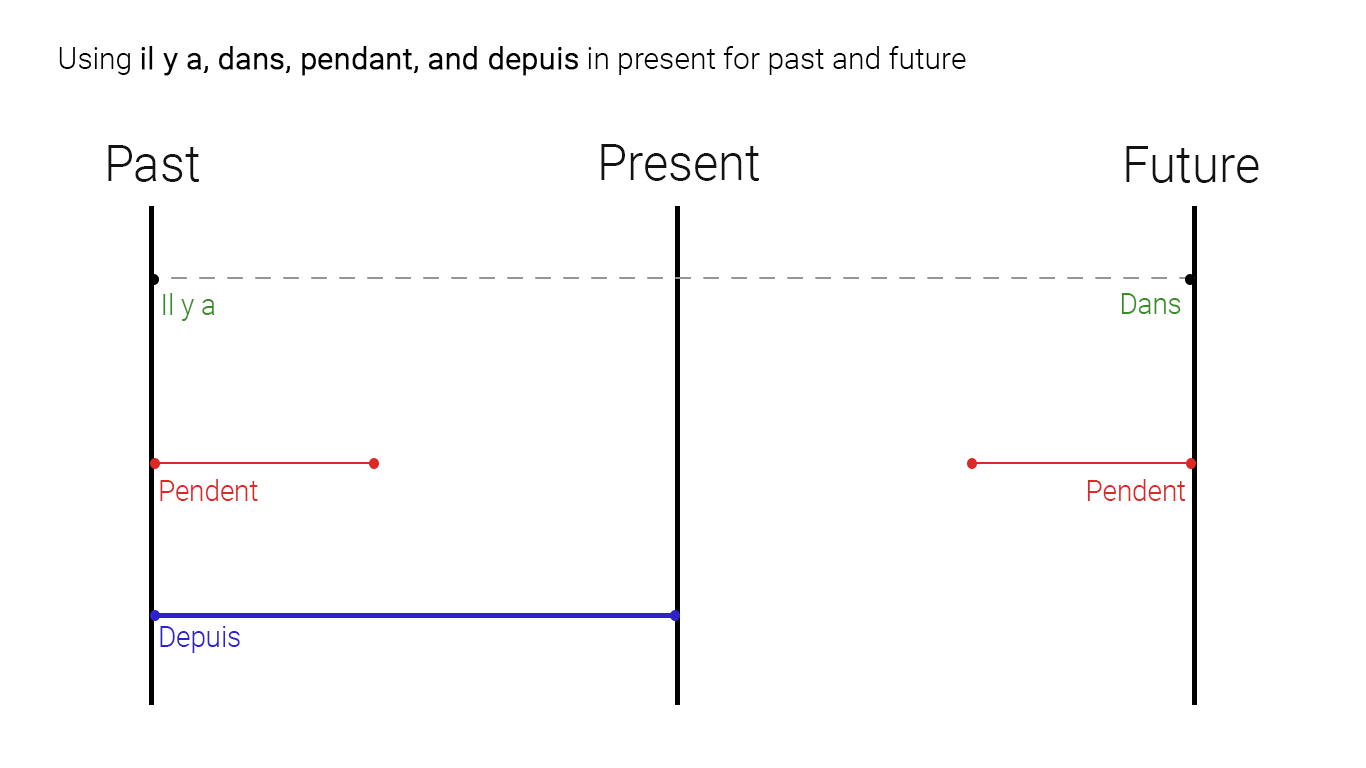
Note: depuis refers to the startng piont of an action whcih is still going on and pendant refers to the duration of the an action which is over; pendant is used with the plusperfectPlus-que-parfait (Pluperfect)
Passé recent (Recent past)
If it describe something that has just happened, just took place, it is used in the present.
venir de + infinitive means 'to have just done'
| Verb | je | tu | il/elle/on | nous | vous | ils/elles |
|---|---|---|---|---|---|---|
| venir | viens | viens | vient | venons | venez | viennent |
-l'avion vient d'arriver(the plane has just arrived)
-je viens de te le dire!(I have just told you!)
-il vient de partir(he just left)
-je viens de manger(I just ate)
-elle vienent d'etudier(she just studied)
Futur (Future)
Futur simple (Future Simple)
Used to express what someone will do or will be doing or something that will happen or will be happening
infinitive + the following endings:
| with je | with tu | with il/elle | with nous | with vous | with ils/elles |
|---|---|---|---|---|---|
| -ai | -as | -a | -ons | -ez | -ont |
Note: verbs ending with -re will drop the e of the infinitive
Example:
| Aimer(to like) | Finir(to finish) | Vendre(to sell) |
|---|---|---|
| j'aimerai | je finirai | je vendrai |
| tu aimeras | tu finiras | tu vendras |
| il/elle aimera | il/elle finira | il/elle vendra |
| nous aimerons | nous finirons | nous vendrons |
| vous aimerez | vous finirez | vous vendrez |
| ils/elles aimeront | ils/elles finiront | ils/elles vendront |
-je ferai la vaisselle demain(I will do the dishes tomorrow)
-j'arriverai tard(I will be arriving late)
The future will be used in time clauses introduces by quand(when) or other conjuctions of time where the future is implied
quand(when)
tant que(as long as)
dés/ aussitôt que(as soon as)
lorsque(when)
pendant que(while)
-il vindra quand il le pourra(he will come when he can)
-je te téléphonerai quand je serai prêt(I will call/phone you when I am ready)
-on ira dés qu'il fera beau(we will go as soon as the weather is fine)
-j'aurai beintôt fini(I will finish soon)
Futur antérieur (Future anterior)
It expresses an action that has not yet taken place, but which will take place before another action(an action that will be completed in the future before another action itself in the future.), expressed by a verb in the simple future or to express an action that will be completed at that time. it is the past of the future
auxiliary (avoir or être) conjugated in the future simple + a past participle.
| Verb | je | tu | il/elle/on | nous | vous | ils/elles |
|---|---|---|---|---|---|---|
| avoir | aurai | auras | aura | aurons | aurez | auront |
| être | serai | seras | sera | serons | serez | seront |
use with avoir and être
| avoir | être | |
|---|---|---|
| je/j' | aurai fini | serai venu |
| tu | auras fini | seras venu |
| il/elle/on | aura fini | Il sera venu elle sera venue |
| nous | aurons fini | serons venus |
| vous | aurez fini | serez venus |
| ils/elles | auront fini | Ils seront venus elle seront venues |
Note: With the auxiliary être, the agreement is made with the subject from which the "s" and "e" came because the subject is plural and feminine respectively
-Le train sera déjà parti quand tu arriveras(The train will already have left when you arrive)
-Dans deux ans, les travaux seront terminés(In two years, the work will be completed)
Futur proche (Future recent)
Used to express the immediate future(about to do something, going to happen)
aller + infinitive
| Verb | je | tu | il/elle/on | nous | vous | ils/elles |
|---|---|---|---|---|---|---|
| aller | vais | vas | va | allons | allez | vont |
-Tu vas partir(You are going to leave)
-je vais vous expliquer ce qui s'est passé(I going to explain(to you) what happened)
-il va déménager la semaine prochaine(he is going to move next week/he will be moving next week)
Irregular stem/radical changes in future tense
| Verb | Stem change | Similar Verb |
|---|---|---|
| appeler(to call) | appeller- | épeler(to spell), rappeler(to recall), renouveler(to renew) |
| appuyer(to lean on) | appuier- | ennuyer(to annoy), essuyer(to wipe) |
| employer(to employ) | emploier- | nettoyer(to clean), noyer(to drown) |
| essayer*(to try) | essaier- | balayer(to sweep), effrayer(to scare), payer(to pay) |
| gérer(to manage/handle)* | gèrer– | célébrer(to celebrate), espérer(to hope), préférer(to prefer) |
| jeter(to throw) | jetter- | feuilleter(to browse), projeter(to project), rejeter(to dismiss) |
| lever(to raise up) | lèver- | acheter(to buy), achever(to finish/complete), mener(to lead), peser(to weigh), geler(to freeze) |
*The future stem change is optional for these two types of stem-changing verbs.
| Verb | Future |
|---|---|
| être(to be) | je serai, tu seras... |
| avoir(to have) | j'aurai, tu auras... |
| -evoir: devoir(to have to), recevoir(to receive), décevoir(to disappoint)... | je devrai etc; je recevrai etc, je décevrai... |
| venir(to come), tenir(to hold) and compounds | je viendrai etc; je tiendrai... |
| voir(to see) and compounds | je verrai... |
| aller(to go) | j'irai... |
| faire(to do) (and compounds) | je ferai... |
| pouvoir(to can, to be able to) | je pourrai... |
| savoir(to know) | je saurai... |
| vouloir(to want to) | je voudrai... |
| falloir(to need to), valoir(to be worth)(Impersonal verbs) | il faudra; il vaudra... |
| pleuvoir(to rain)(Impersonal verbs) | il pleuvra... |
| mouvoir(to move) and compounds | je mouvrai... |
| mourir(to die) | je mourrai... |
| (s')asseoir(to sit) | je m'assiérai... or je m'assoirai... |
| cueillir(to gather), accueillir(to welcome/accomodate) | j'accueillerai... |
| quérir(to fetch/seek) and derived verbs: acquérir(to acquire), conquérir(to conquer) | j'acquérrai... |
Imparfait (Imperfect)
Used to express what someone was doing or what someone used to do or to describe something in the past. The imperfect refers particularly to something that continiued over a period of time. When speaking of a habits in past, discription in past, any background details, the circumtance of the situation(the place, the date, the hour), the emotions, sentiments, and the souvenirs.
stem of the first person plural of the present tense(the nous form minus -ons) + the following endings:
| je | tu | il/elle | nous | vous | ils/elles |
|---|---|---|---|---|---|
| -ais | -ais | -ait | -ions | -iez | -aient |
Example
| Aimer(to like) | Finir(to finish) | Vendre(to sell) |
|---|---|---|
| nous aimons | nous finissons | nous vendons |
| j'aimais | je finissais | je vendais |
| tu aimais | tu finissais | tu vendais |
| il/elle aimait | il/elle finissait | il/elle vendait |
| nous aimions | nous finissions | nous vendions |
| vous aimiez | vous finissiez | vous vendiez |
| ils/elles aimaient | ils/elles finissaient | ils/elles vendainent |
Note : the only irregular imperfect is être
| Verb | j' | tu | il/elle/on | nous | vous | ils/elles |
|---|---|---|---|---|---|---|
| être | étais | étais | était | étions | étiez | étaient |
-
continuous actions
-il prenait un bain quand le téléphone a sonné(he was taking a bath when the phone rang) -excuse-moi, je pensais à autre chose(I am sorry, I was thinking of something else)
Note: the continous nature of the action can be emphasised by using être en train de + infinitive
-j'étais en train de faire le ménage(I was (busy in the process of) doing the housework)
-
regular actions in the past
-je le voyais souvent quand il habitait dans le quartier(I saw him often when he lived in the neighborhood) -quand il était plus jeune il voyageait beaucoup(when he was younger he used to travel a lot) -
descriptin in the past
-il faisait beau ce jour-là(the weather as fine that day) -c'était formidable(it was great) -elle portait une ribe bleue(she wore a blue dress) -elle donnait sur la rue(it looked onto the street) -
to describe an action which had started in the past and was still going on at a given time(using depuis(since, for))
-elle le connaissait depuis son enface(she had known him since (his) childhood) -il attendait depuis trois heures quand on est arrivé(he had been waiting for three hours when we arrived)
But: if the sentence is negative or if the action had been completed, the pluperfect(Plus-que-parfait (Pluperfect)) instead of imperfect.
- il y avait...que + imperfect is used to translate 'for' -il y avait longtemps qu'elle habitait seule/elle habitait seule depuis longtemps(she had lived alone for a long time)
Plus-que-parfait (Pluperfect)
Used to express an action that took place before another which has already taken place in the past. To express past of the past (passé du passé)
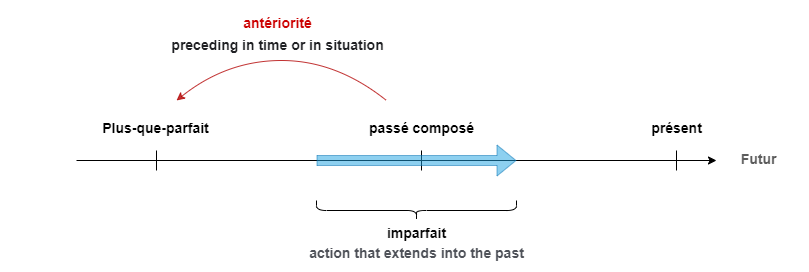
avoir or être of imperfect(imparfait) + past participle
| Verb | j' | tu | il/elle/on | nous | vous | ils/elles |
|---|---|---|---|---|---|---|
| être | étais | étais | était | étions | étiez | étaient |
| avoir | avais | avais | avait | avions | aviez | avaient |
-je n'étais jamais allé(I never went)
-j'avais aussi travaillé(I had also worked)
-il n'avait pas encore développé(he had not yet developed)
-il n'avait pas voulu aller avec eux(he had not wanted to go with them)
-elle était essoufflée parce qu'elle avait couru(she was out of breath because she had been running)
Note: for the conjugation it follwos the same rule as passé composé(perfect past) avoir/être
| avoir | être | |
|---|---|---|
| je/j' | aurai parlé | étais allé(e) |
| tu | avais parlé | étais allé(e) |
| il/elle/on | avait parlé | était allé(e) |
| nous | avions parlé | étions allé(e)s |
| vous | aviez parlé | étiez allé(e)(s) |
| ils/elles | avient parlé | étaient allé(e)s |
- to describe an action which had started in the past and was completed or negative sentence for starting action in past and continuing(using depuis(since, for)) -je n'étais pas allé au théâtre depuis des années(I had not been to the theather for years) -il était parti depuis peu(he had recently left/he had been gone for a short time)
Subjonctif (Subjunctive)
The subjunctive is a French mood (or mode) which expresses the speaker's opinion, desire, emotion, uncertainty, wish, doubt, demand, or a hypothetical situation.Two subjuntive tenses that are generally used are the present and the perfect(passé composé). The imperfect and pluperfect(plus-que-perfait) subjunctive are found mainly in literature or n text of a formal nature. The subjunctive will always be used in a sentence that has a dependent and an independent clause connected by "que" and can only be used in the present and past tenses.
subject + verb + que + subject + verb
-
used after verbs of emotion
être content que(to be pleased/happy that)
être déçu que(to be disappointed that)
être désolé que(to be sorry that)
être étonné que(to be suprised that)
être fâché que(to be annoyed that)\ être heureux que(to happy that)
être surpris que(to be suprised that)
être triste que(to be sad that)
avoir peur que...ne(to be afraid/to fear that)
craindre que...ne(to be afraid/to fear that)
regretter que(to regret that)
-ils étaient contents que j'aille les voir(they were pleased/happy that I went to visit them)
-je serais très étonné qu'il mente(I would be very surprised if he was lying)
-on regrette beaucoup que tu n'aies pas pu vendre ta voiture(we are very sorry that you couldn't sell your car)
Note : ne is used after craindre que or avoir peur que, but does not have a negative meaning in itself
-je crains que l'avoin ne soit en retard(I am afraid that the plane will be late)
-
Verbs of wishing and willing
aimer que(to like)
désirer que(to wish (that))
préférer que(to prefer (that))
souhaiter que(to wish (that))
vouloir que(to want)
-je souhaite que tu réussisses(I hop you will suceed)
-il aimerait que je lui écrive plus souvent(he would like me to write to him more often)
-voulez-vouz que je vous y amène en voiture?(would you like me to drive you there?)
-préférez-vous que je rappelle demain?(would you like me to call back tomorrow?)
-
Impersonal construction (expressing necessity, posibility, doubt, denial, preference)
il faut que(it is necessary that(must))
il est nécessaire que(it is necessary that(must))
il est important que(it is important that)
il est possible que(it is possible that(may))
il est peut que(it is possible that(may))
il est douteux que(it is doubtful that/whether)
il est peu probable que(it is unlikey that)
il semble que(it seems that)
il est préférable que(it is preferable that)
il vaut mieux que(it is (worth) better that(had better))
c'est dommage que(it is a pity that)
Note: can be used in any appropriate tense
-il faut qu'on se dépêche(we have to hurry/we must hurry)
-il était important que tu le saches(it was important that you should know)
-il se pourrait qu'elle change d'avis(she might change her mind)
-il vaudrait mieux que tu ne promettes rien(it would be better if you didn't promise anything/you better not promise anything)
-il est peu probable qu'il s'y intéressent(they are unlikely to be interested in that)
-il semble qu'elle ait raison(it seems that she is right)
-c'est dommage que vous vous soyez manqués(it is a pity that you missed each other)
-
Some verbs and impersonal constuction expressing doubt or uncertainity(mainly used negatively or interrogatively)
douter que(to doubt that)
(ne pas) croire que((not) to believe that)
(ne pas) penser que((not) to think that)
(ne pas) être sûr que((not) to be sure that)
il n'est pas certain que(it is not certain that)
il n'est pas évident que(it is not obvious that)
il n'est pas sûr que(it is not sure that)
il n'est pas vrai que(it is not true that)
-je doute fort qu'il veuille t'aider(I very much doubt that he wants to help you.)
-croyez-vous qu'il y ait des places de libres?(do you think there are any free places?)
-on n'était pas sûr que ce soit le bon endroit(we were not sure that it was the right place)
-il n'était pas certain qu'elle puisse gagner(it was not certain whether/that she could win)
-
attendre que(to wait until, to wait for someone to do something)
-attendons qu'il revienne(let's wait until/for him to come back) -
Subordinating conjunctions
bien que(although)
quoique(although)
sans que(without)
pour que(so that)
afin que(so that)
à condition que(provided that)
pourvu que(provided that)
jusqu'à ce que(until)
en attendant que(until)
avant que...(ne)(before)
à moins que...(ne)(unless)
de peur que...ne(for fear that)
de crainte que...ne(for fear that)
de sorte que(so that)
de façon que(so that)
de maniére que(so that)
Note: When ne is shown in brackets, it may follow the conjuction, although it is rarely used in spoken, it does not have any negative meaning.
-il est allé travailler bein qu'il soit malade(he went to work although he was ill)
-elle est entrée sans que je la voie(she came in without me seeing her)
-voilà de l'argent pour que tu puisse aller au cinéma(here is some money so that you can go the cinema)
-d'accord, pourvu que tu me promettes de ne pas le répéter(all right, as long as you promise not to tell anyone)
-tu l'as revu avant qu'il (ne) parte?(did you see him again before he left?)
-je le ferai demai, à moins que ce (ne) soit urgent(I will do it tomorrow, unless it is urgent)
-elle n'a pas fait de bruit de peur qu'il ne se réveille(she didn't make any noise, in case he would wake up)
-parle moins fort de sorte qu'elle ne nous entende pas(talk more quietly so that she doesn't hear us)
-
A superlative or adjectives like premier(first), dernier(last), seul(only) followed by qui or que
-c'était le coureur le plus rapide que j'aie jamais vu(He was the fastest runner I've ever seen)But: indicative is used with a statement of fact rather than the expression of an opinion -c'est le coureur le plus rapide qui a gagné(it was the fastest runner who won)
-
Negative and indefinite pronouns(eg rien, personne, quelqu'un) followed by qui and que
-je ne connais personne qui sache aussi bien chanter(I do not know anyone who can sing so well) -il n'y a aucune chance qu'il réussisse(he has not got a chance of succeeding) -ils cherchent quelqu'un qui puisse garder le bébé(they are looking for someone who can look after the baby)
Avoiding subjective
Provided that both the verbs in the sentence have the same subject, it is replaced by an infinitive introduced by the preposition de, the preposition à or by no preposition at all (Infinitve verbs)
-
de + infinitive replaces the subjunctive after
-
verb of emotion
-j'ai été étonné d'apprendre la nouvelle(I was surprised to hear the news) -il regrette de ne pas avoir vu cette émission(he is sorry he didn't see this programme) -tu as peur de ne pas avoir assez d'argent?(are you worried you won't have enough money?) -
attendre(to wait) and douter(to doubt)
-j'attendrai d'avoir bu mon café(I will wait ubtil I have drunk coffee) -
most impresonal constructions
-il serait préférable de déclarer ces objets(it would be better to declare these objects) -il est important de garder votre billet(it is important that you should keep your ticket) -
most conjunctions
-il est resté dans la voiture afin de ne pas se mouiller(he stayed in the car so as not to get wet) -j'ai lu avant de m'endormir(I read before falling asleep) -tu peux sortir, à condition de rentrer avant minuit(you can go out, as long as you are back before midnight/you can go out, provided you come back before midnight)
-
-
à + infinitive replaces the subjunctive after
-
de façon/manière
-mets la liste sur la table de mani&re à ne pas l'oublier(put the list on the table so that you won't forget it) -
premier, seul, dernier
-il a été le seul à s'excuser(he was the only one who apologised)
-
-
the infinitive without any linking preposition replaces the subjunctive after
- verbs of wishng and willing
-je voudrais sortir avec toi(I would like to go out with you) - il faut, il vaut mieux
-il vous faudra prendre des chèques de voyage(you will have to take some traveller's cheques) -il lui a fallu recommencer à zéro(he had to start all over again) -il vaudrait mieiux lui apporter des fleurs que des bonbons(it would be better to bring her flowers than sweets)
Note: an indirect object pronoun is often used with il faut to indicate the subject(who has to do something)
- verbs of thinking
-je ne crois pas le connaître(I don't believe I know him) -tu penses être chez toi à cinq heure?(do you think you will be home at five?) - pour and sans
-le car est reparti sans nous attendre(the bus/coach left without waiting for us) -j'économise pour pouvoir acheter une moto(I'm saving so I can buy a motorbike)
- verbs of wishng and willing
Conditionnel (Condtional)
Used to address the if (si) conditions
infinitive(stem of the future) + the following endings:
| with je | with tu | with il/elle | with nous | with vous | with ils/elles |
|---|---|---|---|---|---|
| -ais | -ais | -ait | -ions | -iez | -aient |
Note: verbs ending with -re will drop the e of the infinitive
Example:
| Aimer(to like) | Finir(to finish) | Vendre(to sell) |
|---|---|---|
| j'aimerais | je finirais | je vendrais |
| tu aimerais | tu finirais | tu vendrais |
| il/elle aimerait | il/elle finirait | il/elle vendrait |
| nous aimerions | nous finirions | nous vendrions |
| vous aimeriez | vous finiriez | vous vendriez |
| ils/elles aimeraient | ils/elles finiraient | ils/elles vendraient |
-
The conditional present (hypothése du présent)
Si + imparfait + conditional
-
It is used to describe what someone would do or wold be doing or what would happen (if something else were to happen)
-si j'étais riche, j'achèterais un château(if I was/were rich, I would buy a castle) -si j'avais le temp, j'irais au cinéma(if I had time, I would go to the cinema) -
To make hypothetical comparisons(if I was (that), I would be (that)/if he was (that), he would be (that))
-j'étais un arbre, je serais...(if I was a tree, I would be...) -
It is also used in indirect questions or reported speech instead of the future
il me m'a pas dit s'il viendrait(he didn't tell me if he would come)
-
-
The conditional perfect/past conditional (hypothése du passé)
Si + plu-que-parfait(pluperfect) + conditional passé(past conditional)
-
Used to express what someone would have done or would have been doing or what would have happened(expression of regrest, remorse or reproch)
-si j'avais su, je n'aurais rien dit(if I had known, I wouldn't have said anything) -qu'aurais-je fait sans toi?(what would I have sone without you?)Regret
-Si j'avais eu le temps, je serais allée au parc(If I had time, I would have gone to the park)Remorse
-si j'avais su, je a'aurais pas acheté cette chaise, elle n'est pas confortable(If I had known, I would not have bought this chair, it's not confortable)Reproch si + pluperfect + conditional present
-si tu avais travaillé plus, tu parlerais mieux aujourd'hui(if you had worked more, you would speak better today)
-
-
The conditional future (hypothése du futur)
Used to express something that can happen in the future
Si + present + future simple/ future proche
-si j'ai le temp, j'irai au marché(if I have time, I will go to the market) -si j'ai le temp, je « vais passer » a la boulangerie(if I have time, I'll go to the bakery)Si + présent + impératif
-si tu as le temp, passe à la boulangerie(if you have time, go to the bakery)Si + présent + présent
-s'il pleut, je prends la voiture(if it rains, I take the car) -
tense after si
The tense of the verb introduce by the si is determined by the tense of the verb in the main clause
|Main verb|Verb following si| |--|--| |conditional present|imperfect| |conditional perfect(past)|pluperfect|
-je te le dirais si je le savais(I would tell you if I knew) -je te l'aurais dit si je l'avais suNote: si is used in conditional future only if its meaning is whether (ie when it introduces an indirect question)
je me demande si j'y serais arrivé sans toi(I wonder whether I would have managed without you)
Impératif (Imperative)
It is used to give commands, or polite instructions, or to make request or suggestions; these can be positive (affirmative imperative 'do!') or negative('don't!').The imperative is the only personal verb form that does not require a subject; the verb conjugation alone tells you who is being ordered to do or not to do something. In addition, the imperative exists only for three grammatical persons instead of the normal six.
-mange ta soupe!(eat your soup)
-n'aie pas peur!(don't be afraid!)
-partons!(let's go!)
-entrez(come in!)
-faites attention!(be careful!)
-n'hesitez pas!(don't hesitate!)
-tournez à droite à la poste(turn right at the post office)
- The imperative has only three forms, which are the same as the tu, nous, and vous forms of the present tense, but wothout the subject pronoun
| -er verbs | -ir verbs | -re verbs | |
|---|---|---|---|
| tu | regard(watch) | choisis(choose) | attends(wait) |
| nous | regardons(lets watch) | choisissons(let's choose) | attendons(let's wait) |
| vous | regardez(watch) | choisissez(choose) | attendez(wait) |
Note:
- the -s of the tu form of -er verbs is dropped, except when y or en follow the verb
-parle-lui!(speak to him) But -parles-en avec lui(speak to him about it) -achète de sucre!(buy some sucre!) But -achèttes-en un kilo(buy a kilo of it) - the destination between the subject pronouns tu and vous applies to the tu and vous forms of the imperative
-prends ta soeur avec toi, Alain(take your sister with you, Alain) -prenez le plat du jour, Monsieur ; c'est du poulet rôti(take the dish of the day, sir; it's roast chicken) -les enfant, prenez vos imperméables; il va pleuvoir(children, take your raincoats; it is going to rain)
-
Negative commands the verbs is placed between ne and pas
-ne ais pas ça!(don't do that!) -ne dites rien!(don't say anything!) -
imperative with object pronouns, in positive command object pronouns comes after the verb and are attached to it by a hyphen. In negative commands, they come before the verb
-dites-moi ce qui s'est passé(tell me what happened) -attendons-les!(let's wait for them) -prnds-enbein soin, ne l'abîme pas!(take good care of it, don't damage it) -
Imperative of (Verbes pronominaux (Reflexive verbs)), position of the reflexive pronoun of reflexive verbs is the same as that of the objaect pronouns
-tais-toi!(be quiet!) -levez-vous!(get up!) -méfiez-vous de lui(don't trust him) -arrêtons-nous ici(let us stop here) -ne nous plaignons pas(let us not complain) -ne t'approche pas plus(don't come any closer!) -
Alternative to the imperative
-
Infintive(Verbes infinitifs (Infinitive verbs)) is often used instead of the imperative in written instruction and in recipes
-s'adresser au concierge(see the caretaker) -ne pas fumer(no smoking) -verser le lait et bien mélanger(pour in the milk and mix well) -
Subjunctive; as the imperative has no third person (singular or plural), que + subjunctive is used for giving orders in the third person
-que personne ne me dérange!(don't let anyone disturb me!) -qu'il entre!(let him come in) -qu'elle parte, je m'en fiche!(if she leaves, I don't care)
-
Verbes pronominaux (Reflexive verbs)
They 'reflect' the action back onto the sibject. they are always accompained by a reflexive pronoun
I looked at myself in the mirror myself is a reflexive pronoun
-je lave la voiture(I am wasi=hing the car) je me lave(I am washing myself)
-j'ai couché le bébé(I put the baby to bed) je me suis couché(i went to bed/I put myself to bed)
Reflexive pronouns
| Person | Singular | Plural |
|---|---|---|
| 1st | me(m')(myself) | nous(ourselves) |
| 2nd | te(t')(yourself) | vous(yourself/selves) |
| 3rd | se(s')(himself, herself, itself, oneself) | se(s')(themselves) |
Note
-
m', t' and s' are used instead of me, te and se in front of a vowel or a silent h
-tu t'amuses?- non, je m'ennuie(are you you enjoying yourself? - no, I am bored) -il s'habille â la salle se bain(he gets dressed in the bathroom) -
Reflexive pronouns are often not translated in English
-je me demande si(I wonder if...) -ils se moquent de moi(they're making fun of me) -
Plural reflexive pronouns can also be used to express reciprocal actions; in this case they are translated by 'each other' or 'one another'
-nous nous détestons(we hate one another) -ils ne se parlent pas(they are not talking to each other) -
se can mean 'ourselves' or 'each other' when it is used with the ppronoun on meaning 'we'
-on s'est perdu(we got lost) -on se connaît(we know each other)
Position of reflexive pronouns
They are placed immediately before the verb, except in positive commands, where they follow the verb and are linked to it by a hyphen
-tu te dépêches?(will you hurry up?)
-dépêchons-nous!(let's hurry)
-ne t'inquiète pas(don not worry)
-ne vous fiez pas à lui(don't trust him)
-elle doit se reposer(she needsto rest)
-repose-toi(have a rest)
Conjuagation of reflexive verbs
- Simple tense These are formed in the same way as for the non-reflexive verbs, except that a reflexive pronoun is used
- Compound tense These are formed with auxiliary verb être followed by the past participle of the verb
Agreement of the pst participle
-
In most cases, the reflexive pronoun is a direct object and the past participle of the verb agrees in number and in gender with the reflexive pronoun
-il s'est trompé(he made a mistake) -elle s'est endormie(ahe fell asleep) -ils se sont excusés(they apologized) -elle se sont assises(they sat down) -
When the reflexive pronoun is used as an indirect object, the past participle does not change
-nous nous sommes écrit(we wrote to each other) -elle se l'est acheté(she bought it for herself) -
When the reflexive verb has a direct object, the reflexive pronoun is the indirect object of the reflexive verb and the past participle does not agree with it
-Caroline s'est tordu la cheville(Caroline sprained her ankle) -vous vous êtes lavè les mains, les filles?(did you washed your hands, girls?)
Common reflexive verbs
| Verb | Meaning |
|---|---|
| s'en aller | to go away |
| s'éloigner(de) | to move away(from) |
| se moquer de | to laugh at |
| s'amuser | to have fun |
| s'endormir | to fall asleep |
| s'occuper de | to take care of |
| s'appeler | to be called |
| s'ennuyer | to be bored |
| se passer | to happen |
| s'approcher(de) | to come near |
| s'étonner(de) | to be suprised (at) |
| se passer de | to do without |
| s'arrêter | to stop |
| s'excuser(de) | to apologize (for) |
| se promener | to go for a walk |
| s'asseoir | to sit down |
| se fâcher | to get angry/ fall out |
| se rappeler | to remember |
| s'attendre à | to expect |
| s'écrier | to cry out/exclaim |
| se raser | to shave |
| se baigner | to have a bath |
| s'habiller | to get dressed |
| se renseigner | to make enquiries |
| se battre | to fight |
| se hâter | to hurry |
| se ressembler | to look alike |
| se blesser | to hurt oneself |
| s'inquiéter | to worry |
| se retourner | to turn round |
| se coucher | to go to bed |
| s'installer | to settle down |
| se réveiller | to wake up |
| se débarrasser de | to get rid of |
| se laver | to wash |
| se souvenir (de) | to remember |
| se dépecher | to hurry |
| se mêler de | to meddle with |
| se taire | to be/keep quiet |
| se déshabiller | to undress |
| se mettre à | to start |
| se tromper | to be mistaken |
| se diriger vers | to move towards |
| se mettre en route | to set off |
| se trouver | to be (situated) |
Verbes impersonnels (Impersonal verbs)
Impersonal varbs are used only in the third person singular and in the infinitive. The subject is always the impersonal pronoun il= it
-il neige(it is snowing)
-il y a du brouillard(it is foggy)
Verbs describing the weather
-
faire + adjective
-il fait beau/chaud(it is fine/warm) -il fait frais/froid(it is cool/cold) -il fera beau demain(the weather will be good tomorrow) -il va faire très froid(it will be very cold) -
faire + noun
-il fait beau temps(the weather is nice) -il fait mauvais temps(the weather is bad)
Note
```
-il fait jour(it is day (light))
-il fait nuit(it is dark)
```
il gèle (geler) it is freezing il grêle (grêler) it is hailing **il neige ** (neiger) it is snowing il pleut (pleuvoir) it is raining il tonne (tonner) it is thundering
Note: some of these verbs may be used personally
-je gèle(I am freezing)
-
il y a + noun
-il y a des nauges(it is cloudy) -il y a du brouillard(it is foggy) -ily a du verglas(it is icy)
être
-
il est + noun
-il est cinq heures(it is five o'clock) -il était une fois un géant(there was once a gaint) -
il est + adjective + de + infinitive
-il est difficle de(it is difficult to) -il est facile de(it is easy to) -il est nécessaire de(it is necessary to) -il est inutile de(it is useless to) -il est possible de(it is possible to) -il est difficile d'en parler(it is difficult to speak about it)
Note: il « m'est » difficile d'en parler(it is difficult for me to speak about it)
-
il est + adjective + que
-il est douteux que(it is doubtful that) -il est évident que(it is clear that) -il est possible que(it is possible that) -il est probable que(it is probable that) -il est peu probable que(it is unlikely that) -il est vrai que(it is true that)*Note: que may be followed bt the indicative or the subjunctive *
-il est probable qu'il ne viendra pas(it is probable that he won't some) -il esr peu probable qu'il vienne(it is unlikely that he will come)
arriver, se passer (to happen)
-il est arrivé une chose curieuse(a strange thing happened)
-que se passe-t-il?(what's happening?)
exister(to exit), rester(to reamin), manquer(to be missing)
-il existe trois exemplaire de ce livre(there are three copies of this book)
-il me restait six centimes(I had six cents left)
-il me manque vingt centimes(I am twenty cents shorts/ I am missing twenty cents)
paraître, sembler(to seem)
-il paraîtrait/semblerait qu'il ait changé d'avis(it would appear that he has changed his mind/it seems that he has changed his mind)
-il paraît qu'il va se marier(it seems he is going to get married)
-il me semble que le professeur s'est trompé(it seems to me that the teacher has made a mistake)
Other common impersonal verbs
-
s'agir(to be matter of/about) may be followed by a noun, a pronoun or an infinitive
-il s'agit de ton avenir(it is about your future) -de quoi s'agit-il?(what is it about?) -il s'agit de trouver le coupable(it's about finding the culprit) -
falloir(to be necessary)
may be followed by a noun, an infintive or the subjunctive
-il faut deux heures pour aller à paris(it takes two hours to get to Paris) -il me faut plus de temps(I need more time) -il faudra rentrer plus tôt ce soir(we will have to come home earlier tonight) -il faut que tu parles à Papa(you need to talk to dad) -
suffire(to be enough (only/just))
may be followed by a noun, an infintive or the subjunctive
-il suffit de peu de chose puor être heureux(it takes less things to be happy) -il suffit de passer le pont(you only have to cross the bridge) -il suffira qu'ils te donnent le numéro de téléphone(they just need to give you the phone number) -
valoir mieux(to be better)
may be followed by a noun, an infintive or the subjunctive
-il vaudrait mieux prendre le car(it would be better to take the bus) -il vaut mieux que vous ne sortiez pas seule le soir(it is better that you do not go out alone at night)
Verbes infinitifs (Infinitive verbs)
The infinitve is the basic from of the verb. It is recognized by its ending, which is found in three forms corresponding to the three conjugation: -er, ir, re
These endings give the verb the meaning 'to...'
acheter(to buy) choisir(to choose) vendre(to sell)
-
After a preposition
Can be used after some preposition (pour, avant de, sans, au lieu de, afin de)
-sans attendre(without waiting) -avant de partir(before leaving) -
After a verb
-
Verbs followed by the infinitive with no linking preposition
verb of wishing and willing
vouloir(to want)
souhaiter(to wish)
désirer(to wish, to want)
espérer(to hope)-voulez-vous manger maintenant ou plus tard?(do you want to eat now or later?) -je souhaite parler au directeur?(I wish to speak to the manager?)verb of seeing, hearing, and feeling
voir(to see)
écouter(to listen to)
regarder(to watch)
sentir(to feel, to smell)
entendre(to hear)-je l'ai vu jouer(I have seen him play) -tu m'as regardé danser?(did you watched me dance?) j'ai entendu quelqu'un crier(I heard someone shout)verb of motion
aller(to go)
monter(to go/come up)
venir(to come)
entrer(to go/come in)
rentrer(to come home/ to return, to go in again)
sortir(to come out)
descendre(to come down)-je viendrai te voir demain(I will come to see you tomorrow) -il est descendu laver la voiture(he went down to was the car) -va acheter le journal(go and buy the paper)aller + inifinitive to express a future action(someone is going to do)
-qu'est-ce que tu vas faire demain?(what are you going to do tomorrow?)verb of liking and disliking
aminer(to like)
adorer(to love)
aimer mieux(to prefer/ to like better)
détester(to hate)
préférer(to prefer)-tu aimes voyager?(do ou like travelling?) -j'aime mieux attendre(I prefer to wait) -je déteste aller à la campagne(I hate going to the country) -j'adore faire la grasse matinée(I love making a big lie/ exp- I love sleeping late)More verbs
compter(to intent to)
sembler(to seem)
laisser(to let go)
faillir(to nearly (do))
oser(to dare)-ils l'ont laissé partir(they let him go) -je n'ose pas le lui demander(I dare not ask him) -tu semble être malade(you seem to be ill) -je compte partir demain(I intend to leave tomorrow) -j'ai failli manquer l'avion(I nearly missed the plane)In following set of expressions
aller chercher(to go and get/ to fetch)
envoyer chercher(to send for)
entendre dire(que)(to hear (that))
entendre parler de(to hear about)
laisser tomber(to drop)
venir chercher(to come and get)
vouloir dire(to mean)-va chercher ton argent(go and get your money) -j'ai entendu dire qu'il était journaliste(I have heard that he was a journalist) -tu as entendu parler de ce film?(have you heard about this film?) -ne le laisse pas tomber!(do not drop it!) -ça veut dire 'demain'(it means 'tomorrow') -
Verbs followed by à + infintive(list of verb in chapter verb construction)
-je dois aider ma mère à préparer le déjeuner(I must help my mother prepare lunch) -il commence à faire nuit(it is beginning to get dark) -alors, tu t'es décidé à y aller?(so you have made up your mind to go?) -je t'invite à venir chez moi pour les vacances de Noël(I invite you to come to my house for the Christmas holidays) -je passe mon temps à lire et à regarder la télé(I spend my time reading and watching TV) -cela sert à nettoyer les disques(this is used for cleaning records) -
Verbs followed by de + infintive(list of verb in chapter verb construction)
-je crois qu'il s'est arrêté de pleuvoir(I think it is stopped raining) -tu as envie de sortir?(do you feel like going out?) -le médecin a conseillé à Serge de rester au lit(the doctor advised Serge to stay in bed) -j'ai décidé de rester chez moi(I decided to stay st home) -essayons de faire du stop(let us try to stop) -demande à Papa de t'aider(ask your Dad to help you) -je t'interdis d'y aller(I forbide you to go) -n'oublier pas d'en acheter!(do not forget to buy some!) -j'ai refusé de le faire(I refused to do it) -je vous prie de m'excuser(please forgive me) -il vient de téléphoner(he just called)
-
-
After a noun , a pronoun, an adverb or an adjective
-
with the linking preposition à
-il avait plusieurs clients à voir(he had several customers to see) -c'est difficile à dire(it is difficult to say) -
with the linking preposition de
-je suis content de te voir(I am pleased to see you) -
de or à with pronouns, adverbs or nouns?
à conveys the idea of something to do or to be done after the following
beaucoup(a lot)
plus(more)
tant(so much)
trop(too much)
assez(enough)
moins(less)
rien(nothing)
tout(everything)
quelque chose(something)-une maison à vendre(a house for sale) -j'ai des examens à préparer(I have exams to prepare) -il nous a indiqué la route à suivre(he showed us the road to follow) -il y a trop de livres à lire(there are toomany books to read) -il n'y a pas de temps à perdre(there is no time to lose) -c'était une occasion à ne pas manquer(it was an opportunity not to be missed)de is used after nouns of an abstract nature, usually with the definite article
l'habitutde de(the habit of)
l'occasion de(the opportunity to)
le temps de(the time to)
le courage de(the courage to)
l'envie de(the desire to)
le besoin(the need to)
le plaisir de(the pleasure of)
le moment de(the time to)-il n'avait pas l'habitude d'être seul(he wasn't used to being alone) -je n'ai pas le temps de lui parler(I don't have time to talk to him) -avez-vous eu l'occasion de la rencontrer?(did you have the opportunity to meet her?) -ce n'est pas le moment de le déranger(now is not the time to disturb him) -je n'ai pas eu le courage de le lui dire(I didn't have the courage to tell him) -
de or à with adjectives?
à is used in passive sense (something to be done) and after c'est
-un livre agréable à lire(a fun book to read) -il est facile à satisfaire(he is easily satisfied) -c'est intéresssant à savoir(that os interesting to known) -c'était impossible à faire(it was impossible to do)de is used after many adjectives, in particular those where the idea of "of" is present in English
certain/sûr de(certain of/to)
capable de(capable of)
incapable de(incapable of)
coupable de(quilty of)-j'étais sûr de réussir(I was sure of succeeding) -il est incapable d'y arriver seul(he is incapable of managing on his own)de is also used with adjective of emotion, feeling and generally with adjective denoting a state of mind
content de(pleased/ happy to)
surpris/ étonné de(surprised to)
fier de(proud to)
heureux de(happy to)
fâché de(annoyed to/at)
triste de(sad to)
gêné de(enbarrassed to)
désolé de(sorry for/ to)-j'ai été très content de recevoir ta lettre(I was very pleased to get your letter) -elle sera surprise de vous voir(she will be surprised to see you) -nous avons été très tristes d'apprendre la nouvelle(we were very sad to hear the news)But: à is used with prêt(ready to) and disposé(willing to)
-es-tu prête à partir?(are you rady to go?) -je suis tout disposé à vous aider(I am very willing to help you)
-
-
faire + infintive
To express th esense of having someone do something or having something done
-
with one object
-je dois le faire réparer(I must have it fixed) -il veut faire repeindre sa voiture(he wants to have his car resprayed) -je ferai nettaoyer cette veste; je la ferai nettoyer(I will have this jacket cleaned; I will have it cleaned) -tu m'as fait attendre!(you made me wait) -je le ferai parler(I will make him talk)Note: faire entrer(to show in), faire venir(to send for)
-faites entrer ce monsieur(show this gentleman in) -je vais faire venir le docteur(I will send for the doctor) -
when both faire and the following infintive have an object, the object of faire is indirect
-elle lui a fait prendre une douche(sh emade him take a shower) -je leur ai fait ranger leur chambre(I made them tidy their room)
-
-
Infinitive used as subject of another verb
-trouver un emploi n'est pas facile(finding a job isn't easy)
The perfect infinitive
The perfect or past inifinitve is formed with the infinitive of the auxiliary avoir or étre as appropriate and followed by the past participle of the verb
avoir mangé(to have eaten)
être allé(to have gone)
s'être levé(to have got up)
-
after the preposition après(after)
-après avoir attendu une heure, il est rentré chez lui(after waiting for an hour, he went back home) -il s'en est souvenu après s'être couché(he remembered after going to bed) -
after certain verbs
se souvenir(to remember)
remercier de(to thank for)
regretter de(to regret, to be sorry for)
être désolé de(to be sorry for)-je vous remercie de m'avoir invité(I thank you for inviting me) -il regrettait de leur avoir menti(he was sorry for lying to them) -tu te souviens d'avoir fait cela?(do you remember doing this?)
Le passif (The passive)
It is used to show interest in the person or object that experiences an action rather than the person or object that performs the action/ when the subject does not perform the action, but is subjected to
The road is being repaired. (we are interested in the road, not in the people who are doing the repairs.)
The passive is formed with the conjugated verb être + the past participle of the main verb. Être is conjugated into the same tense as that of the active form.
-j'ai été invité(I was invited)
-elle a été renvoyée(she has been dismissed)
-ils seront déçus(they will be disappointed)
-elles ont été vues(they were seen)
Avoidance of the passive
-
Use of the pronoun on
-on m'a volé mon portefeuille(my wallet has been stolen) -on construit une nouvelle piscine(a new swimming pool is being built) -
Agent becomes subject of the verb
-la nouvelle va les surprendre(they will be surprised by « the news ») -mon correspondent m'a invité(i have been invited by « my penfriend ») -mon cadeau te plaît?(are you pleased with « my present? ») -
Use of a reflexive verbs=
Reflexive forms can be created for a large number of verbs, particularly in the third person
-elle s'appelle Anne(she is called Anne) -ton absence va se remarquer(your absence will be noticed) -ce plat se mange froid(this dish is eaten cold) -cela ne se fait pas ici(that isn't done here) -
se faire + infinitve (when the subject is a person)
-il s'est fait renverser par une voiture(he was run over by a car) -je me suis fait voler tout mon argent(I have been robbed of all my money)
Verbes auxiliaires modaux (Modal auxiliary verbs)
Followed by infinitive, they express an obligation, an intention, a probaility, a possibility or a wish rather than a fact
-
Devoir
Expresses obligation, necessity, probability, intention, expectation
-
obligation
-nous devons arriver à temps(we must arrive in time) -demain tu devra prendre le bus(tomorrow you will have to take the bus) -nous avions dû partir(we had to go) -j'ai dû avouer que j'aivais tort(I had to admit that I was wrong)In the conditional devoir may be used for advise, ie to express what should be done (conditional present) or should have been done (past conditional)
-vous devriez travailler davantage(you ought to /should work harder) -tu ne devrais pas marcher sur l'herbe(you shoould not walk on the grass) -tu aurais dû tout avouer(you should have admitted everything) -tu n'aurais pas dû manger ces champignons(ou shouldn't have eaten those mushrooms) -
probability
-il doit être en train de dormir(he must be sleeping (he is probably sleeping)) -j'ai dû me tromper de chemin(I must have raken the wrong road) -il dit qu'il avait du se tromper de chemin(he said he must taken the wrong raod) -
intention, expectation
-je dois aller chez le dentiste(I am supposed to go to the dentist's) -le train doit arriver à 19h30(the train is die to arrive at 7:30 PM)
-
-
Pouvoir
Expresses capacity, ability, permission, possibility
-
capacity, ability
-Superman peut seulever une maison(Superman can lift a house) -cette voiture oeut faire du 150(this car can go up to 93mph) -il était si faible qu'il ne pouvait pas sortir de son lit(he was so weak that he couldn't get out of bed) -
permission
-puis-je entrer?(may i come in?) -puis-je vous offrir du thé?(may I offer you some tea?) -
possibility
-cela peut arriver(it can arriver)Note: puovoir + the infinitive is usually replaced by peut-être and the finite tense; il s'est peut-être trompéde livres(he may have taken the wrong books)
In conditional pouvoir is used to express something that could or might be (conditional present) or that could or might have been (past conditional)
-tu pourrais t'excuser(you might apologize) -j'aurais pu vous prêter mon magnétophone(I could have lent you my tape recorder)Note: with verb of perception (eg entendre to hear, sentir to feel, to smell, voir to see)
-j'entendais le bruit des vagues(I could hear the sound of the waves)
-
-
Pouvoir
Means "to know how to"
-je sais/savais conduire une moto(I know/knew how to drive a motorcycle) -
Vouloir
Expresses desire, wish, intention
-
desire
-je veux partir(i want to go) -voulez-vous danser avec moi?(will you dance with me?) -
wish
-je voudrais être un lapin(I wish I were a rabbit) -je voudrais trouver un travail intéressant(I should like to find an interesting job) -j'aurais voulu lui donner un coup de poing(I would have liked to punch him) -
intention
-il a voulu sauter par la fenêtre(he tried to jump out of the window)Note: veuillez the imperative of vouloir is used as a polite form to express a request (would you please)
-veuillez ne pas déranger(please do not disturb)
-
-
Falloir
Expresses necessity
-il faut manger pour vivre(you must eat to live) -il faudrait manger plus tôt ce soir(we should eat earlier tonight) -il aurait fallu appoerter des sandwichs(we should have brought sandwiches)
Épellation irrégularités (spelling Irregularities)
Spelling irregularities only affect -er
- Verbs ending with -cer and -ger
-
cer adding ç before an a or an o tp preserve the soundh of the c
-
ger requires -e after the g before an a or an o
Example: commencer, manger
| Present | Imperfect | |
|---|---|---|
| commencer | ||
| je | commence | commençais |
| tu | commences | commençais |
| il/elle/onn | commence | commençait |
| nous | commençon | commencions |
| vous | commencez | commenciez |
| ils/elles | commencent | commencent |
| manger | ||
| je | mange | mangeais |
| tu | manges | mangeais |
| il/elle/onn | mange | mangeait |
| nous | mangeons | mangions |
| vous | mangez | mangiez |
| ils/elles | mangent | mangeaient |
Present Participle
commençant mangeant
Same conjugation with all the verb forms past, subjunctive (conjugation)
- Verbs ending with -eler and -eter
- -eler double the l before -e, -es, -ent
Example: appeler
| present | future | conditional | |
|---|---|---|---|
| j' | appelle | appellerai | applellerais |
| tu | appelles | appelleras | applellerais |
| il/elle/onn | appelle | appellera | applellerait |
| nous | appelons | appellerons | applellerions |
| vous | appelez | appellerez | applelleriez |
| ils/elles | appellent | appelleront | applelleraient |
But: some verbs in -eler including the following are conjugated like acheter
| Verb | Meaning |
|---|---|
| celer | to conceal |
| congeler | to deep-freeze |
| déceler | to detect, reveal |
| dégeler | to defrost |
| geler | to freeze |
| harceler | to harass |
| marteler | to hammer |
| modeler | to model |
| peler | to peel |
- -eter takes double t before -e, -es, -ent
Example : jeter (to throw)
| present | future | conditional | |
|---|---|---|---|
| j' | jette | jetterai | jetterais |
| tu | jettes | jetteras | jetterais |
| il/elle/onn | jette | jettera | jetterait |
| nous | jetons | jetterons | jetterions |
| vous | jetez | jetterez | jetteriez |
| ils/elles | jettent | jetteront | jetteraient |
But: some verbs in -eter including the following are conjugated like acheter
| Verb | Meaning |
|---|---|
| crocheter | to pick(lock) |
| fureter | to snoop |
| haleter | to pant(short, quick breaths) |
| racheter | to buy back |
- Verb ending with -oyer and -uyer the y changes to i before -e, -es, -ent
Example : employer (to use) and ennuyer(to bore)
| present | future | conditional | |
|---|---|---|---|
| j' | emploie | emploierai | emploierais |
| tu | emploies | emploieras | emploierais |
| il/elle/onn | emploie | emploieras | emploierait |
| nous | employons | emploierons | emploierions |
| vous | employez | emploierez | emploieriez |
| ils/elles | emploient | emploieront | emploieraient |
Note: envoyer(to send) and renvoyer(to dismiss) have an irregular future and conditional: j'enverrai, j'enverrais, je renverrai, je renverrais
- Verbs ending in -ayer change from y to i is optional eg: baleyer(to sweep), payer(to pay), essayer(to try)
je balaie or balaye
je paie or paye
j' essaie or essaye
- Verb in e + consonant + er like acheter, enlever, mener, peser change the last e of the stem to è before -e, -es, -ent
Example : acheter(to buy)
| present | future | conditional | |
|---|---|---|---|
| j' | achète | achèterai | achèterais |
| tu | achètes | achèteras | achèterais |
| il/elle/onn | achète | achètera | achèterait |
| nous | achetons | achèterons | achèterions |
| vous | achetez | achèterez | achèteriez |
| ils/elles | achètent | achèteront | achèteraient |
Verbs like acheter
| Verb | Meaning |
|---|---|
| celer | to conceal |
| congeler | to deep-freeze |
| déceler | to detect, reveal |
| dégeler | to defrost |
| geler | to freeze |
| harceler | to harass |
| marteler | to hammer |
| modeler | to model |
| peler | to peel |
| crocheter | to pick(lock) |
| fureter | to snoop |
| haleter | to pant(short, quick breaths) |
| racheter | to buy back |
| achever | to complete |
| amener | to bring |
| crever | to burst |
| élever | to raise |
| emmener | to take away |
| enlever | to remove |
| étiqueter | to label |
| lever | to lift |
| mener | to lead |
| peser | to weigh |
| se promener | to go for a walk |
| semer | to sow |
| soulever | to lift |
- Verb in é + consonant + er like espérer(to hope) change é to è before -e, -es, -ent in present and subjunctive but in the future and conditional é is retained
Example : espérer
| present | future | conditional | |
|---|---|---|---|
| j' | espère | espérerai | espérerais |
| tu | espères | espéreras | espérerais |
| il/elle/onn | espère | espérera | espérerait |
| nous | espérons | espérerons | espérerions |
| vous | espérez | espérerez | espéreriez |
| ils/elles | espèrent | espéreront | espéreraient |
Verbs like espérer includes verbs in -éder, -érer, -éter
| Verb | Meaning |
|---|---|
| accéder | to accede to |
| céder | to yield |
| célébrer | to celebrate |
| compléter | to complete |
| considérer | to consider |
| décéder | to die |
| digérer | to digest |
| gérer | to manage |
| inquiéter | to worry |
| libérer | to free |
| opérer | to operate |
| pénétrer | to penetrate |
| presévérer | to persevere |
| posséder | to possess |
| précéder | to precede |
| préférer | to prefer |
| protéger | to protect |
| récupérer | to recover |
| refréner | to curb |
| régler | to rule |
| régner | to reign |
| répéter | to repeat, rehearse |
| révéler | to revel |
| sécher | to dry |
| succéder | to succeed |
| suggérer | to suggest |
| tolérer | to tolrate |